
 Credit: Inside the Magic
If you’ve been anywhere near Walt Disney World over the past couple of weeks, you didn’t need an official announcement to know something was off.
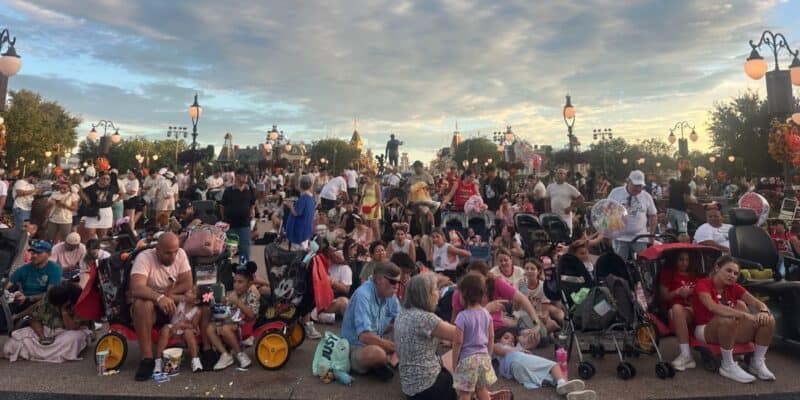
You could feel it the moment you stepped onto Main Street, U.S.A. The crowds weren’t just heavy—they were relentless. Walkways tightened. Lightning Lane return times vanished early in the day. And standby lines? They stretched into territory that felt closer to peak holiday chaos than a typical spring visit.
What we’re seeing right now is the result of a perfect storm: spring break crowds colliding with limited ride capacity, ongoing refurbishments, and a surge of demand that Disney hasn’t fully been able to absorb. And while Disney hasn’t outright declared a full park closure or capacity lock, all signs point to the resort hitting its internal thresholds—what many seasoned fans would call a “capacity trigger” moment.
Wait Times Are Telling the Story
The numbers coming out of last week paint a pretty clear picture of just how intense things have gotten. Multiple attractions across Walt Disney World have seen average wait times climb well beyond what most guests would consider manageable.
According to reports from AllEars, at EPCOT, Guardians of the Galaxy: Cosmic Rewind averaged a staggering 99-minute wait, making it one of the most in-demand attractions on property right now. That’s not a peak wait—that’s the average across the entire week. Right behind it, Star Wars: Rise of the Resistance at Disney’s Hollywood Studios crossed the 90-minute mark as well.
And it doesn’t stop there. EPCOT alone had five attractions averaging over an hour, including Frozen Ever After, Remy’s Ratatouille Adventure, and Soarin’. Meanwhile, at Magic Kingdom, TRON Lightcycle / Run hovered around 76 minutes on average, with Seven Dwarfs Mine Train and Space Mountain not far behind.
When you zoom out and look at the full picture, it’s clear: this isn’t just one busy ride or one crowded park. This is system-wide pressure.
A Resort Pushed to Its Limits
Spring break has always been one of the busiest times of the year, but 2026 feels different. There’s a noticeable lack of breathing room across the parks. Normally, guests can pivot—if one park feels overwhelming, another might offer some relief. Right now, that strategy isn’t working.
Hollywood Studios is packed thanks to its heavy-hitter lineup, EPCOT is absorbing massive crowds due to its festivals and headliner rides, and Magic Kingdom remains the default choice for families. Even Animal Kingdom, which typically offers a slower pace, is seeing Avatar Flight of Passage average around 70 minutes.
What’s making this worse is the current ride availability. With attractions like Big Thunder Mountain Railroad and Buzz Lightyear’s Space Ranger Spin temporarily closed for refurbishment, the guest load is being funneled into fewer experiences. That creates a ripple effect—longer lines everywhere, fewer “break” attractions, and more congestion in already crowded areas.
The Lightning Lane Factor
Then there’s Lightning Lane, which continues to reshape how crowds move through the parks. On paper, it’s designed to reduce wait times for those who pay for it. In reality, it’s also contributing to longer standby lines when demand spikes like this.
With Lightning Lane Multi Pass selections booking up earlier in the day and Single Pass attractions selling out quickly, more guests are being pushed into standby queues. That’s part of why we’re seeing these unusually high average wait times across multiple parks.
And let’s not forget Lightning Lane Premier Pass, which has been hitting sell-out levels even at premium pricing. That tells you everything you need to know about demand right now—guests are willing to pay almost anything to avoid these lines.

Subtle Signs of Capacity Being Reached
Disney rarely announces when a park is “full” in the traditional sense anymore. Instead, they manage capacity through reservation systems, controlled entry points, and internal thresholds. But if you know what to look for, the signs are there.
Transportation delays start stacking up. Mobile order return windows stretch further into the afternoon. Cast Members begin directing foot traffic more aggressively in high-congestion areas. Even something as simple as finding a place to sit becomes a challenge.
These are all indicators that the parks are operating at or near their maximum comfortable capacity—even if the gates never officially close.
Why This Feels Different From Past Years
There have always been busy seasons at Walt Disney World. But what’s happening now feels more intense because of how the parks are currently structured.
You have fewer low-capacity attractions soaking up crowds. You have higher demand driven by new offerings and pent-up travel interest. And you have a system that increasingly rewards planning ahead—leaving spontaneous guests at a disadvantage.
The result? A resort that feels less flexible and more strained when demand spikes.
If you’re planning a trip in the immediate future, especially during the tail end of spring break, expectations need to shift.
This is not the time for a relaxed, go-with-the-flow park day. You’ll need a strategy. Rope drop matters more than ever. Lightning Lane selections need to be locked in early. And even then, you should be prepared for longer waits than you might be used to.
For some guests, this level of crowding can turn what should be a magical experience into a frustrating one. For others, it’s just the reality of visiting during one of the busiest times of the year.

A Breaking Point—or the New Normal?
The bigger question is whether this is a temporary surge or a sign of things to come.
With major expansions still on the horizon and Epic Universe now open across town, Disney is clearly in a transitional period. But right now, demand is outpacing what the parks can comfortably handle on a day-to-day basis.
And if the past couple of weeks are any indication, Walt Disney World isn’t just busy—it’s operating right at the edge.
Whether you call it a capacity trigger or just an overwhelming crowd surge, one thing is certain: the magic is still there—but you’re going to have to work a lot harder to find it.