7
7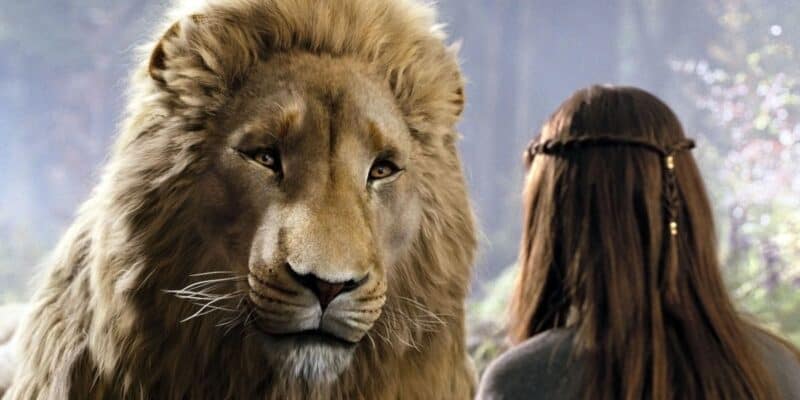
 Credit: Disney
Greta Gerwig is making some pretty big changes for her upcoming take on The Chronicles of Narnia – starting with Aslan.
The Chronicles of Narnia is C.S. Lewis’ seven-book fantasy series set in the magical world of Narnia, where Aslan serves as its powerful lion protector in what’s often considered an allegory for Jesus. The character has been adapted several times, with Ronald Pickup voicing him in the BBC’s late-1980s and early-1990s television series.

For the big screen, Aslan became a fully CGI creation. Liam Neeson voiced the character in Disney’s The Lion, the Witch and the Wardrobe (2005) and returned for Prince Caspian (2008) and The Voyage of the Dawn Treader (2010), giving the character his most recognizable modern voice.
But for the upcoming Netflix adaptation, Meryl Streep is taking over the role, marking the first time a woman has voiced Aslan in a major screen adaptation and prompting talk of a franchise “gender-swap.”
Greta Gerwig’s Take on Aslan
Meryl Streep’s casting as Aslan was officially confirmed on September 17, when Empire unveiled its first look at Gerwig’s Narnia: The Magician’s Nephew. The reveal also showed off Aslan’s new design, complete with different-colored eyes and a red stripe through his fur inspired by David Bowie.
Gerwig said she wanted someone who could bring both “gravitas” and “joy and delight” to the role. She specifically sought an actor over 70 who could convey decades of experience while still possessing a childlike sense of wonder, ultimately landing on Streep.
First look at Aslan in Greta Gerwig’s ‘NARNIA’ movie.
Voiced by Meryl Streep.
(Source: @empiremagazine)
First look at Aslan in Greta Gerwig's ‘NARNIA’ movie.
Voiced by Meryl Streep.
(Source: @empiremagazine) pic.twitter.com/LGlALgofRV
— DiscussingFilm (@DiscussingFilm) September 17, 2026
The Bowie influence also reflects Gerwig’s broader approach to the film. She has drawn on rock music while developing her version of Narnia, fitting The Magician’s Nephew, in which Aslan sings Narnia into existence, and its landscape begins to take shape around him.
Streep is the first woman to voice Aslan in a major screen adaptation, but that does not necessarily mean Gerwig has actually gender-swapped the character from male to female. The first official image still depicts Aslan as a maned lion, while Empire’s coverage consistently uses male pronouns.
For now, the apparent “gender-swap” is in the casting rather than Aslan’s identity, with Streep taking over a role previously voiced by men. However, that hasn’t stopped some book loyalists from criticizing the move on social media, accusing Netflix and Gerwig of making “REALLY weird decisions” and “stupid.”
Others have defended the move, arguing on Reddit that “Jesus’ life and death are no more or less divine if they are told allegorically with a woman’s voice. It literally is not that hard.”
Similarly, one fan wrote, “Jesus takes the form of a talking lion—also an albatross, a lamb, and a cat. Aslan shape-shifts. There is no reason that a woman cannot VOICE the talking lion that is Jesus in our world.”
Other Changes in Gerwig’s Take on Narnia
That’s not Gerwig’s only departure from previous versions. Netflix is starting with The Magician’s Nephew, the sixth Narnia book published, but the first chronologically. It has never previously received a feature film adaptation, meaning Gerwig is introducing Narnia through its creation rather than the Pevensie children.
🚨 First look at Emma Mackey as Jadis and Charn in Greta Gerwig’s Narnia: The Magician’s Nephew
🚨 First look at Emma Mackey as Jadis and Charn in Greta Gerwig’s Narnia: The Magician’s Nephew pic.twitter.com/si0zvUitkq
— NarniaWeb (@NarniaWeb) September 17, 2026
She has also shifted the story forward by more than half a century. Lewis’ novel takes place around 1900, but filming has placed Gerwig’s version in 1955 – coincidentally the year The Magician’s Nephew was published – with period cars, clothing, and London streets reflecting postwar Britain.
Music will play a much bigger role, too. Gerwig has said the idea of Aslan singing Narnia into existence has stayed with her since childhood, while Barbie collaborators Mark Ronson and Andrew Wyatt are composing the score. Gerwig has also revealed that she initially approached the project as a “rock opera.”
That timeline shift could also create a bigger problem later on in the franchise.
The Lion, the Witch, and the Wardrobe is closely tied to World War II, with the Pevensie children sent out of London during the Blitz. If Gerwig keeps her Narnia films in one continuous timeline, moving The Magician’s Nephew to 1955 could force Netflix to rethink when later stories take place – or abandon the wartime setting entirely.

Gerwig has been attached to multiple films, although Netflix has not confirmed which book she will tackle next, while the streamer holds the rights to all seven novels.
The Magician’s Nephew hits theaters worldwide on February 12, 2027, before arriving on Netflix on April 2. It is not Netflix’s first movie to play theatrically, but it is a major first for the streamer: a global wide release with a full theatrical window, rather than the limited runs traditionally given to its films.
The Magician’s Nephew follows Digory Kirke (David McKenna) and Polly Plummer (Beatrice Campbell), two children who are transported between different worlds after experimenting with magical rings created by Digory’s uncle (Daniel Craig). Their journey ultimately brings them to Narnia’s creation, where they witness Aslan bring the world to life and inadvertently help introduce the White Witch (Emma Mackey) into it.
Are you excited for Narnia: The Magician’s Nephew?