 Credit: Disney
It is time to talk about trash cans again. That sentence should be embarrassing to write in August. It is not, because this has genuinely become one of the longest-running Walt Disney World storylines of the year. What started as a single test unit at EPCOT’s Germany Pavilion in December 2024 has become a resort-wide operational change that guests notice across every park.
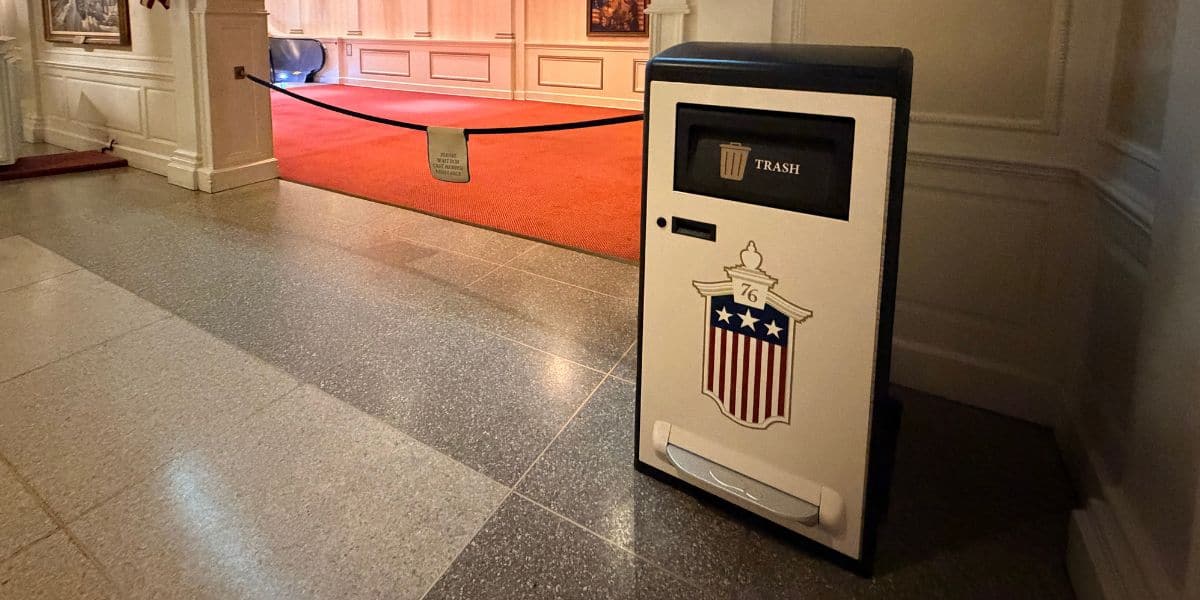
We have spent most of this summer tracking the EPCOT rollout, watching World Showcase convert pavilion by pavilion, and debating whether the generic brown cans at Japan and Italy were a missed opportunity compared to the patriotic ones at The American Adventure.
Today, the focus shifts to Disney’s Animal Kingdom, and this park is doing something noticeably different.
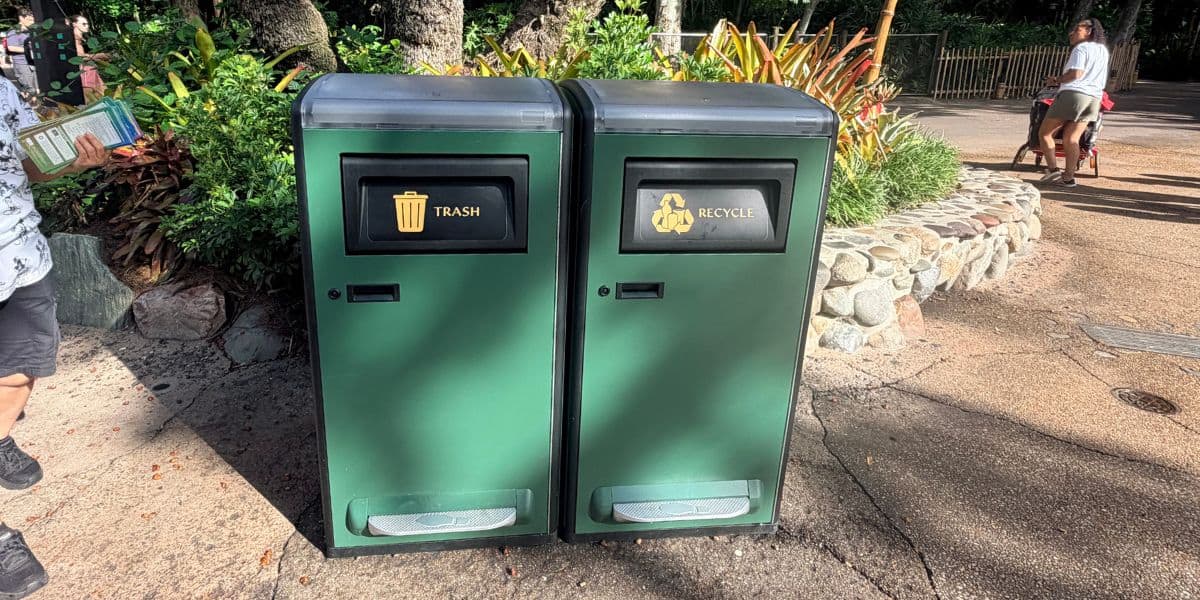
A little over a week ago, solar-powered trash cans appeared along the Maharajah Jungle Trek with minimal theming. One week later, more have arrived.
New Cans in Asia
Two new sets have been spotted in Asia.
The trash cans are deep green. On the side, they feature art of a red triangle with a tiger in the center and clouds in the corners.
That artwork is not new to the land. The older brown cans in Asia featured the same tiger design, and Disney carried it over to the new units rather than starting from scratch.
These join others previously installed at the Maharajah Jungle Trek and at the front of the park.
New Cans at Discovery Island Trails
The other new installation is at Discovery Island Trails.
These cans are dark green and feature a gold-yellow image of The Tree of Life.
That design connects to the units that arrived at the park entrance plaza and The Oasis back in July, which carried the same Tree of Life artwork.
Why Animal Kingdom Is Handling This Better
Here is the comparison worth making.
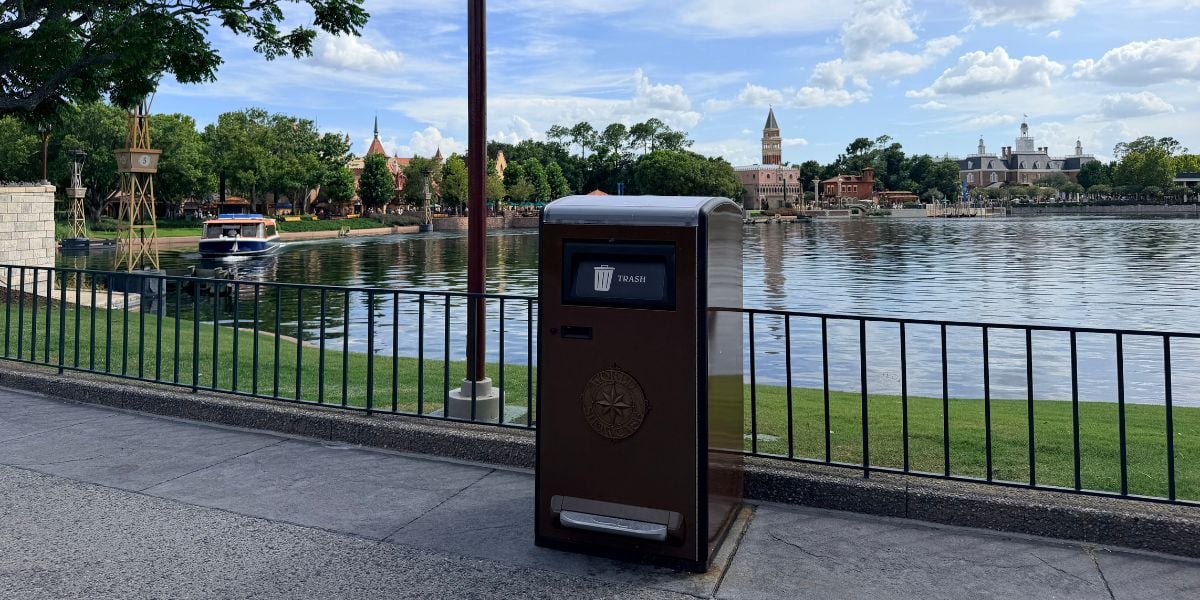
Over at EPCOT, most World Showcase pavilions have received plain brown cans with a generic World Showcase compass medallion. The American Adventure got a genuinely custom design. Japan and Italy did not.
Animal Kingdom is doing the opposite. The entrance and Oasis cans got Tree of Life artwork. The Asia cans got the tiger. Discovery Island Trails got Tree of Life in a different color treatment.
That is, location-specific design is applied consistently rather than selectively, and it matters more at this park than at most.
Animal Kingdom leans heavily on environmental storytelling. Buildings, signage, pathways, props, vegetation, and even ordinary operational equipment all contribute to the atmosphere. Dropping generic smart cans throughout the park would run counter of its entire premise.
Walt Disney Imagineering has been involved in the design process specifically so that the new units resemble the older-style cans they replace.
What Makes These Different From Regular Trash Cans
For anyone who has not encountered one yet, these are not simply bigger bins.
The solar panels on top power a built-in trash compactor, letting each unit hold significantly more waste before it needs attention.
Guests place trash or recycling through a mailbox-style opening on the front. The lids can be opened by hand or by foot pedal.
They also come in pairs, with one unit for trash and one for recycling.
Sensors can alert custodial cast members when cans approach capacity, which is arguably the most useful feature operationally. Rather than having cast members continuously check individual cans, the technology flags which ones actually need service.
That matters in parks welcoming tens of thousands of guests daily, particularly during crowded periods when food locations, walkways, and attraction exits generate waste fast.
Disney World Had to Make a Tutorial
The hand-or-pedal design has confused enough guests that Disney released an instructional video explaining how to use them.
That is not a joke. Guests have struggled to locate the opening, and some have attempted to put trash into parts of the unit that are not openings at all.
Part of the problem has been inconsistency across locations. Some versions have prominent handles that make the opening obvious. Others do not.
The Disney World Transition Is Visibly Incomplete
One of the more interesting things about Animal Kingdom right now is that you can see the change happening.
Traditional brown cans remain in parts of Asia, particularly as guests move toward Expedition Everest. That means old and new versions sit relatively close together, giving a clear snapshot of what the land looked like before this started.
Disney appears to be replacing units gradually rather than converting entire lands at once, which is why the picture looks uneven from one pathway to the next.
Where the Rollout Stands Overall at Disney World
The scale becomes clearer with the timeline laid out.
- December 2024: first test unit at EPCOT’s Germany Pavilion
- May 2025: roughly 10 units around the Germany Pavilion
- June 2026: Disney confirms expansion across all four theme parks, both water parks, and Disney Springs, with Walt Disney Imagineering involved in design
- July 2026: Animal Kingdom joins with themed cans at the entrance plaza and The Oasis
- August 2026: Asia and Discovery Island Trails receive new units
Magic Kingdom also received earlier test units that did not carry the same level of location-specific theming.
The Trash Can Table Question
One concern fans raised early on appears to have resolved itself.
Guests at EPCOT festivals have long used flat trash can lids as makeshift tables when seating runs out. The curved solar panels looked like they might end that tradition.
They did not. Guests have already demonstrated the new cans still work as improvised dining surfaces, and trays have been spotted stacked on units near grab-and-go locations around Feathered Friends in Flight.
What to Expect Next at Disney World
Asia’s conversion is not finished, and neither is Animal Kingdom’s.
With Disney committed to all four theme parks, both water parks, and Disney Springs, these units are going to become a standard part of the Walt Disney World landscape.
The open question is whether other parks follow Animal Kingdom’s approach to theming or EPCOT’s. Based on what has appeared this month, Animal Kingdom is setting the better example.