1
1
 Credit: Disney
When a multi-million-dollar, state-of-the-art Audio-Animatronic breaks down at a Disney theme park, it usually triggers a wave of guest complaints and operational frustration. However, a sudden mechanical failure inside New Orleans Square at Disneyland Park has had the exact opposite effect.

On the morning of Saturday, July 4, 2026, just eight days after its highly publicized global debut, the groundbreaking new transforming pirate animatronic inside Disneyland’s Pirates of the Caribbean ground to a complete halt.
The abrupt failure was documented by theme park news outlet MouseInfo, which reported that the figure was completely unresponsive during the busy holiday rush.
Yet, rather than mourning the temporary loss of Disney’s latest technological achievement, the theme park community has exploded into a state of absolute celebration. For a vocal segment of the Disney fanbase, the breakdown of this high-tech figure has accidentally fixed the attraction, instantly restoring a beloved, centuries-old atmosphere that many felt had been ruined just a week prior.
The Hype: Inside Imagineering’s “Secret” New Technology
The controversial figure officially debuted on Friday, June 26, 2026, capping off a two-month operational refurbishment that began in early May. While standard theme park maintenance usually involves fresh layers of paint and mechanical lubrication, Walt Disney Imagineering used the hiatus to execute a highly secretive project developed behind locked doors inside their specialized Research & Development laboratory.
The attraction unveiled a first-of-its-kind, hybrid transforming Audio-Animatronic. Positioned atop a massive pile of cursed gold coins in the ride’s early cavern sequences, the figure utilized a patented synthesis of old-school robotics and futuristic 3D fabrication.
Unlike traditional expressive animatronics that rely on flexible silicone skin driven by dozens of tiny micro-motors, this figure’s head was built around a rigid, meticulously sculpted 3D-printed shell with zero moving facial parts. To achieve human expressions and a live transformation, Disney mapped a high-fidelity front-projection system powered by Epic Games’ Unreal Engine directly onto the complex curves of the 3D-printed surface.
Speaking at the project’s launch, Leslie Evans, Executive R&D Imagineer at Walt Disney Imagineering, emphasized that the technology was built entirely to enhance audience immersion. “We don’t build technology for technology’s sake. Everything is about telling a great story to our guests,” Evans noted, explaining that the goal was to create a flawless illusion of a living pirate melting into bare bones without requiring sudden lighting blackouts or physical screen barriers.
Ironically, this projection-hybrid format was specifically engineered to eliminate the industry’s biggest headache: mechanical wear and tear. By removing the fragile rubber skin, hydraulic lines, and miniature motors that frequently tear and burn out, Disney believed they had built an incredibly robust, low-maintenance figure. Yet, just over a week into a punishing Southern California summer, the underlying robotic framework suffered a catastrophic system freeze.
The “Cursed Loop” That Violated Ride Lore
The specific narrative programmed into the new animatronic is precisely what drove a wedge between Disney’s corporate creative teams and core park purists.
As guest boats drift into the treasure grotto, they are introduced to a living pirate marveling at his riches. The pirate picks up a cursed gold coin, immediately triggering an ancient hex that freezes him in time and transforms his mortal form into a hollow-eyed skeleton.
Horrified, he drops the coin, reverting to human flesh. But, consumed by insatiable pirate greed, his hand inevitably reaches out to grab the treasure again, trapping him in a continuous, supernatural loop.
While casual tourists marveled at the fluid visual transition, dedicated theme park historians argued that the addition fundamentally violated the foundational storytelling of the 1967 classic.

For nearly six decades, the opening caverns of Pirates of the Caribbean functioned on an architectural theory known as “a pirate’s life in reverse.” The ride intentionally begins in a somber, frozen-in-time graveyard. Guests quietly drift past motionless skeletons—a captain at the helm of a ghost ship, a pirate clutching a bottle of rum, and a skeleton inspecting gold with a magnifying glass.
The power of these scenes relied entirely on absolute silence and still bones. It represented the eerie, mystical aftermath of a story that ended centuries ago, allowing every rider to fill in the blanks with their own imagination.
By placing a loud, hyper-expressive, constantly moving animatronic right in the middle of the grotto, Disney broke the somber mood. The eye was immediately yanked toward the frantic movement, shattering the atmospheric tension before boats plunged down the waterfalls into the living past.
“No Grunting or Oohing”: Why Fans Are Celebrating the Breakdown
The biggest grievance among riders, however, wasn’t just the visual distraction—it was the noise. To convey the torment of the supernatural curse, Disney paired the animatronic’s transformation with a barrage of loud, echoing sound effects.
On online forums like Reddit, frustrated fans widely panned the audio design, calling the soundtrack a series of “obnoxious grunts and noises” that drowned out the attraction’s classic musical score and ambient wind loops.

This background context explains why the theme park community reacted with pure joy when MouseInfo confirmed the figure’s breakdown on July 4, stating: “No grunting, oohing, or movement down in the Caribbean this morning.”
Floating past the treasure hoard on Independence Day, holiday crowds were treated to a beautifully ironic sight. The advanced, shape-shifting pirate was completely frozen in place, his projection system darkened and his robotic limbs paralyzed.
By failing, the broken animatronic accidentally granted fans their exact wish: it transformed the figure back into a quiet, motionless, macabre prop, instantly restoring the haunting, mysterious ambiance that defined the 1967 masterpiece.
The Future of Imagineering’s Tech Rollouts
The swift collapse of the Pirates of the Caribbean figure serves as a cautionary tale for a data-driven Disney enterprise that increasingly favors high-tech digital overrides over traditional, physical theatrical illusions. While digital projection mapping and real-time game engines offer unprecedented flexibility on paper, they often struggle to meet the relentless, high-volume operational demands of a real-world theme park environment.
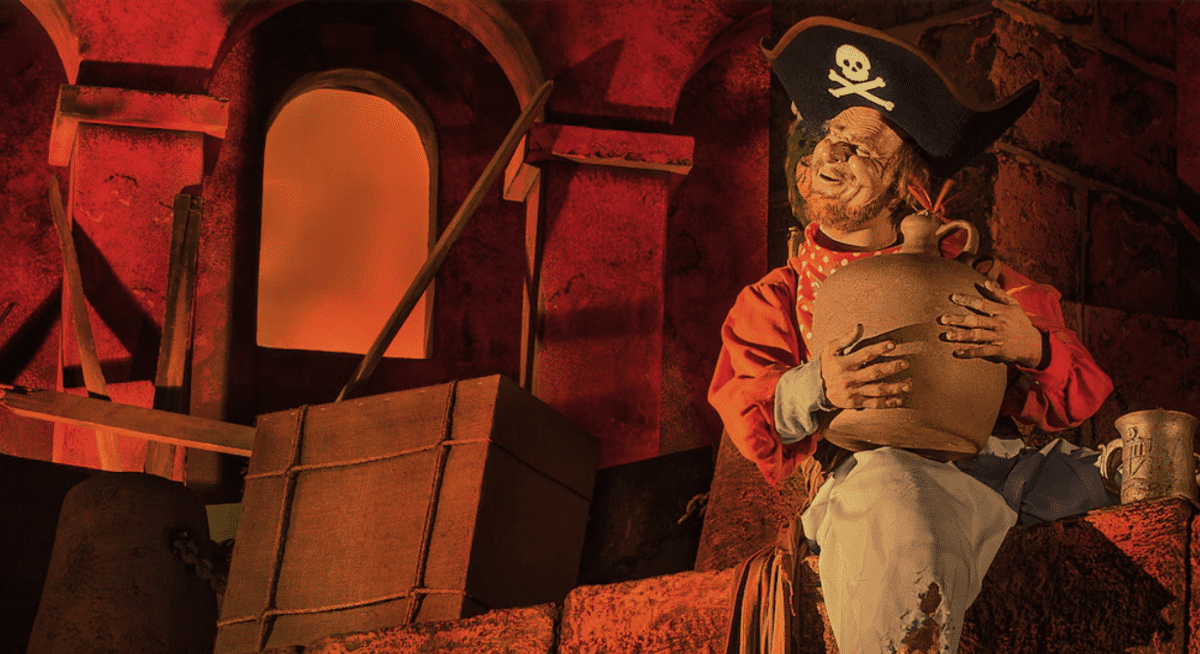
As Disneyland’s maintenance and engineering teams inevitably work backstage to patch the software errors and revive the greedy pirate, purists are savoring every moment of the unexpected silence. The brief, chaotic lifecycle of the transforming pirate highlights a timeless truth that Disney’s R&D labs occasionally forget.
In the world of themed entertainment, sometimes a motionless skeleton left to the imagination is far more powerful than a high-tech machine that explains the whole story.