Credit: Disney
Today marks a monumental shift in theme park history. On Friday, June 26, 2026, Disneyland’s legendary Pirates of the Caribbean attraction officially welcomed guests back following a highly anticipated refurbishment that began in early May. While standard park refurbishments typically entail fresh coats of paint, gear lubrication, and minor lighting adjustments, Walt Disney Imagineering used this brief operational hiatus to install a piece of technology so secretly advanced it completely rewrites the playbook on how physical theme park characters interact with their environments.

For the first time, Disney has introduced a hybrid, transforming Audio-Animatronic that leverages state-of-the-art 3D-printing technology and real-time game engines to seamlessly mutate a character’s physical face from a living human to a decaying, hollow-eyed skeleton right before your eyes. This groundbreaking figure breathes fresh life into an iconic cavern scene, signaling a bold new era for Disney Parks storytelling.
The New Narrative: The Endless Cursed Loop
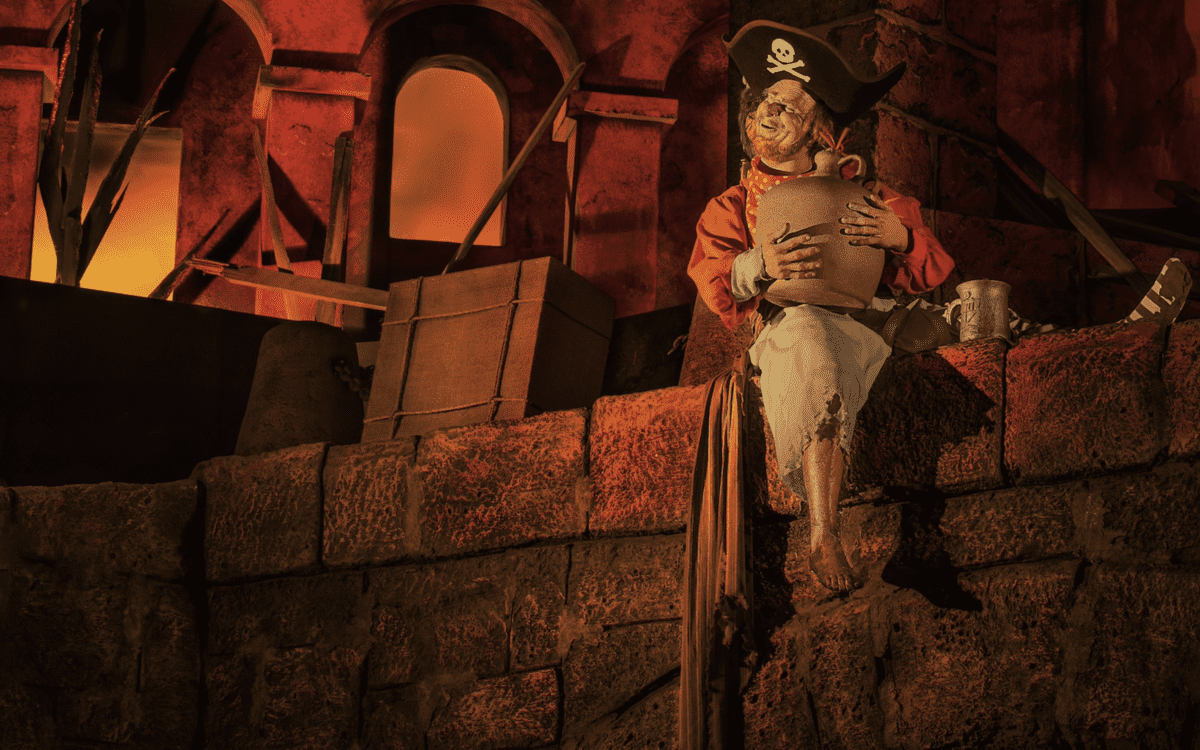
The focus of this mind-boggling technical upgrade is the beloved skeleton resting atop a massive pile of cursed gold coins inside the ride’s early cavern sequences. This visual staple has fascinated generations of riders. For decades, this figure remained a static, macabre prop reminding guests of the dangers of a pirate’s life. Now, skeletal remains are a living, breathing component of the ride’s supernatural lore.
Imagineering has crafted a distinct, localized narrative loop for this newly animated pirate. As a ride vehicle drifts past the treasure hoard, guests see a living pirate marveling at his riches. The figure picks up a cursed gold coin, immediately triggering an ancient hex that freezes him in time and transforms his mortal form into a terrifying skeleton. Realizing the horror of the curse, he drops the coin, releasing him from the magical bond and reverting him to living flesh. Yet, consumed by a pirate’s insatiable greed, his robotic hand inevitably reaches out to grab the gold once more, trapping him in a continuous, terrifying supernatural loop.
The Tech Breakdown: 3D Printing Meets Spatial Projection Mapping
How exactly did Disney pull off a live, physical transformation with no physical screen barriers, camera cuts, or sudden lighting blackouts? The secret lies in an elegant, high-tech marriage of old-school mechanics and futuristic 3D fabrication.
While the animatronic’s underlying body frame uses classic Disney robotic frameworks to achieve smooth, lifelike arm and torso movements, the face is entirely revolutionary. Rather than using flexible silicone skin driven by dozens of tiny, prone-to-failure micro-motors, the character’s head is built around a rigid, meticulously engineered 3D-printed shell. This custom-molded shell features absolutely no visible moving parts.
Instead of relying on mechanical shifting to alter facial features, the pirate’s expressions, blinking eyes, and ultimate skeletal decay are achieved via a high-fidelity projection system precisely mapped onto the complex curves of the 3D-printed surface. By marrying custom 3D printing with real-time game engines and hyper-detailed computer-generated (CG) assets, the light matches the face’s physical geometry flawlessly. The illusion appears completely solid to the human eye, preserving the texture of human skin until the real-time engine commands the flesh to melt away into bare bone.
Insights from the Walt Disney Imagineering R&D Lab
This secret project was developed behind tightly locked doors inside Walt Disney Imagineering’s specialized Research & Development laboratory. Speaking about the historic milestone, Leslie Evans, Executive R&D Imagineer at Walt Disney Imagineering Research & Development, shed light on the creative vision that drove the project.

“We’re really going after more tools to just tell stories in an incredible way,” Evans explained. According to Evans, the selection of the classic 1967 boat ride was highly intentional, as the team was actively “looking for a figure where creatively we could do a great transformation.” Ultimately, the team decided that “this pirate transformation would be a great, great first place to do it.”
The true breakthrough came when several cutting-edge entertainment and software industries converged seamlessly in the R&D lab. “When you really had animatronic technology, real-time game engines, and incredible CG assets all together… that’s when we said, wait, we’ve really got something here,” Evans noted, describing the resulting combination as “a very exciting tool.”

Crucially, Evans emphasized that the development of this 3D-printed hybrid technology wasn’t merely a flex of cutting-edge engineering, but rather a tool entirely subservient to the art of audience immersion. “We want them to believe it’s real… we’re trying to make people feel,” she added. “We don’t build technology for technology’s sake. Everything is about telling a great story to our guests.”
Why 3D-Printed Animatronics Are the Future of Disney Parks
This 3D-printed projection hybrid directly addresses a massive, decades-old challenge for theme park operators: mechanical wear and tear. Traditional Audio-Animatronics, especially those with hyper-expressive human faces, rely on complex networks of cables, high-pressure hydraulics, or miniature electric actuators hidden beneath a delicate rubber or silicone mask.
Over time, constant environmental friction causes the rubber to tear, hydraulic lines to leak, and micro-motors to burn out, leading to immersion-breaking glitches or extensive, costly maintenance downtime.
By transitioning to a static, 3D-printed facial shell with a specialized projection mapping engine overlay, Disney has effectively removed the most fragile mechanical failure points from the figure’s face. There are no robotic eyelids to jam, no silicone lips to tear, and no mechanical cheeks to freeze up mid-show.
The maintenance team can update the character’s expressions, alter skin tones, correct lighting profiles, and adjust the pacing of the transformation entirely through software adjustments in a game engine, rather than physically ripping apart a robotic skull behind the scenes.
A New Era of Interactive Refurbishments
Furthermore, because the animatronic’s face relies heavily on real-time game engine architecture, this figure opens up the mind-boggling possibility for dynamic, reactive storytelling in future ride updates. Because the face is a projection mapped onto a 3D shell, the figure could theoretically be programmed to react dynamically to its environment—altering its gaze to look directly at a passing ride vehicle, shifting its dialogue based on the time of day, or adopting unique, limited-edition overlays for the Halloween and Christmas seasons without requiring a physical overhaul.

As Pirates of the Caribbean reopens its gates today at Disneyland, it stands as a triumphant testament to Walt Disney’s foundational philosophy of “plussing” classic rides remaining fully alive in 2026. This elegant synthesis of 3D printing, advanced computer graphics, and classic puppetry honors the ride’s legacy while rocketing its technology squarely into the future.
The next time you float through the dark caverns of Pirates’ opening scene, keep your eyes locked on the treasure piles. You might just witness the very future of theme park technology melting from a greedy human smile into a cursed skeletal grin.