
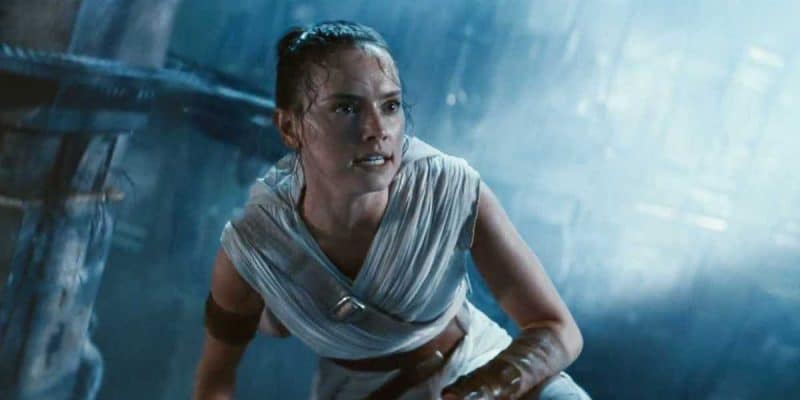
 Credit: Lucasfilm
“Nope.”

Even after surpassing the $1 billion milestone at the global box office, Star Wars: Episode IX—The Rise of Skywalker (2019) struggled to land as a satisfying conclusion to the sequel trilogy. Years later, the franchise is still navigating the aftermath, with expanded storytelling across comics, novels, and television attempting to clarify lingering plot threads and character arcs left unresolved by J. J. Abrams’ divisive finale.
The challenges weren’t limited to the trilogy’s closing chapter. Rian Johnson’s Star Wars: Episode VIII—The Last Jedi (2017) sparked intense debate among fans, creating a divide that carried through to the final installment. At the time, some viewers even called for Lucasfilm to abandon the sequel-era narrative entirely.
Instead, the studio doubled down, bringing Abrams back after his work on Star Wars: Episode VII—The Force Awakens (2015) to wrap up the story, aiming to unify a fractured fan response.

Led by Daisy Ridley as Rey, the sequel trilogy introduced a new generation of characters, including John Boyega’s Finn, Oscar Isaac’s Resistance pilot Poe Dameron, and Adam Driver’s Kylo Ren—a conflicted Force user torn between legacy and identity.
Kylo Ren, in particular, emerged as one of the trilogy’s most layered figures. However, many fans were left dissatisfied with his trajectory, which saw him confront the Knights of Ren, form a mysterious Force connection with Rey, and ultimately sacrifice himself—returning to his identity as Ben Solo before dying in her arms.
In the years since, Lucasfilm has worked to expand and refine elements of the sequel-era story. This includes revisiting key developments—such as the return of Emperor Palpatine, played by Ian McDiarmid—through supplemental material. Notably, a recent comic adaptation of The Rise of Skywalker even altered aspects of the film’s ending.

Several characters have received additional attention in these expanded narratives. Among them are a Kylo Ren-centered storyline set between The Last Jedi and The Rise of Skywalker, as well as the Rey-focused “Jaws of Jakku,” which explores events within the same period.
At one point, Lucasfilm appeared interested in continuing Ben Solo’s story on the big screen.
“I was always interested in doing another Star Wars,” Adam Driver told Associated Press. “I had been talking about doing another one since 2021. Kathleen (Kennedy) had reached out. I always said: With a great director and a great story, I’d be there in a second. I loved that character and loved playing him.”

Driver went on to explain that he brought the concept for a post-The Rise of Skywalker film centered on Kylo Ren to director Steven Soderbergh.
“Soderbergh and Rebecca Blunt outlined a story that the group then pitched to Kennedy, Lucasfilm vice president Cary Beck, and Lucasfilm chief creative officer Dave Filoni,” the outlet wrote. “They were interested, so the filmmakers then pulled in Scott Z. Burns to write a script.”
According to Driver, the screenplay stood out as “one of the [coolest] scripts” he had encountered. Still, despite internal enthusiasm, the project ultimately failed to secure approval from Disney leadership.

“We presented the script to Lucasfilm. They loved the idea. They totally understood our angle and why we were doing it,” Driver said. “We took it to Bob Iger ([Disney CEO]) and Alan Bergman ([co-Chairman of Disney Entertainment]), and they said no. They didn’t see how Ben Solo was alive. And that was that.”
The proposed film reportedly carried the title The Hunt for Ben Solo, signaling a story that would have addressed the character’s fate following his apparent death. While questions about Ben Solo’s survival were a key sticking point, the broader reception to the sequel trilogy likely played a role. Revisiting that chapter of the timeline so soon after a contentious conclusion may have been viewed as a risk.
Now, new comments from Soderbergh have confirmed the end of this Ben Solo movie. When asked by The Playlist about whether he intends to return to The Hunt for Ben Solo now that Lucasfilm and Disney are under new leadership, Soderbergh bluntly said “nope.” According to the report, this came after a discussion around whether Tony Gilroy’s Andor had contributed to the potential movie’s development.

“Well, I don’t want to say [it had no influence], because then it makes it seem like, you know, ‘I watched Andor, and it had absolutely no impact on me,’ which is not true, it was great,” he explained. “But this was [all] before Andor aired. Adam and I started talking, and this would have been almost three years ago now.”
Soderbergh went on to explain that the process was still meaningful, even though the movie never came to fruition.
“It was strictly Adam saying, ‘I think there’s still somewhere to go with this character.’ That’s how it started. Otherwise, I never in a million years would have found myself in that universe again,” he admitted. “I don’t regret one minute of the time we spent working on that,” he said. “I felt the work was good. It’s just good for you to be in that room and working on it. It’s like CrossFit—it’s good for you. It’ll have a residual effect that will be unexpected at some point.”

Instead, Lucasfilm has shifted its focus. When Shawn Levy’s Star Wars: Starfighter (2027) arrives, it will mark nearly a decade since the studio last explored the post-sequel era in a theatrical release.
In the interim, much of the franchise’s attention has been directed toward the New Republic period—the timeline between the original and sequel trilogies—through interconnected Disney+ series often referred to as the Mando-Verse. That era is set to make its theatrical debut with Jon Favreau’s The Mandalorian and Grogu (2026).
For now, no active projects feature the central characters of the sequel trilogy. Back in 2023, Kathleen Kennedy outlined plans for three films, including one centered on Rey Skywalker in a “New Jedi Order” setting years after The Rise of Skywalker. However, progress on that project appears to have slowed, with Starfighter moving ahead more quickly. The shift raises questions about when—or if—Lucasfilm will return to that corner of the saga.
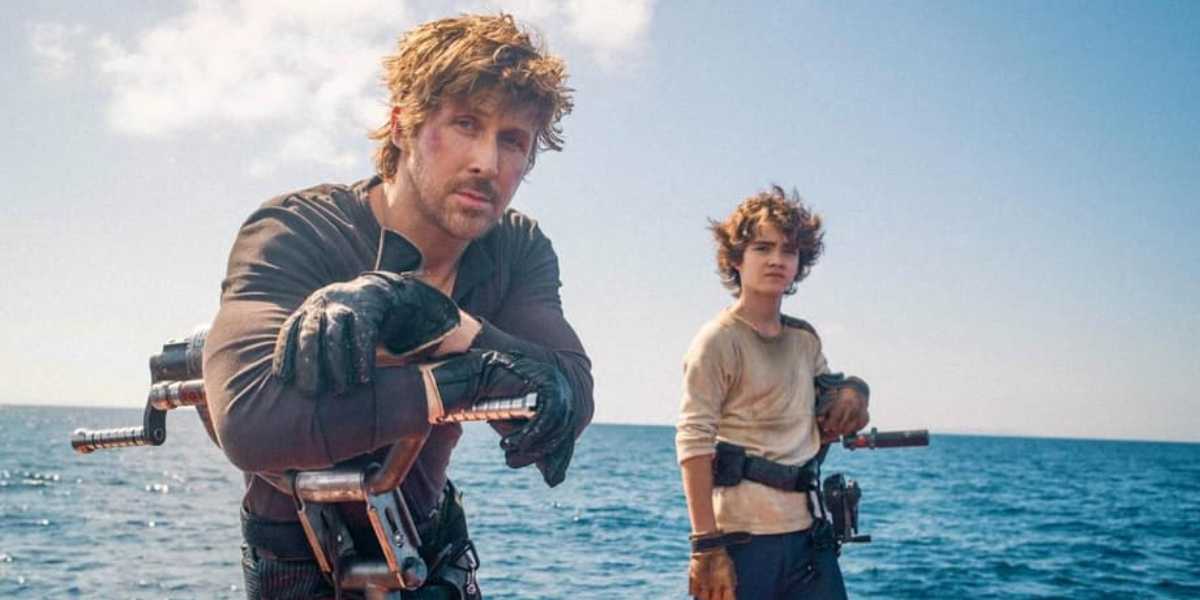
As the franchise recalibrates, the path forward remains uncertain. With a reduced live-action television slate, the apparent conclusion of The Mandalorian coming this year, and a slate of standalone theatrical projects, Star Wars seems to be entering another transitional phase.
Whether audiences remain engaged with the evolving direction of the galaxy far, far away is an open question—but it’s one Lucasfilm will soon have to answer.
How do you feel about the Kylo Ren movie never happening? Let Inside the Magic know in the comments down below!