

 Credit: Disney (Edit ITM)
For a brief moment, the illusion cracked.
Not in a subtle way. Not in the kind of way guests shrug off as “technical difficulties.” This was different. This was loud, sudden, and deeply unsettling — the kind of moment that makes a crowd collectively inhale and forget they’re watching a performance that’s been running safely for decades.
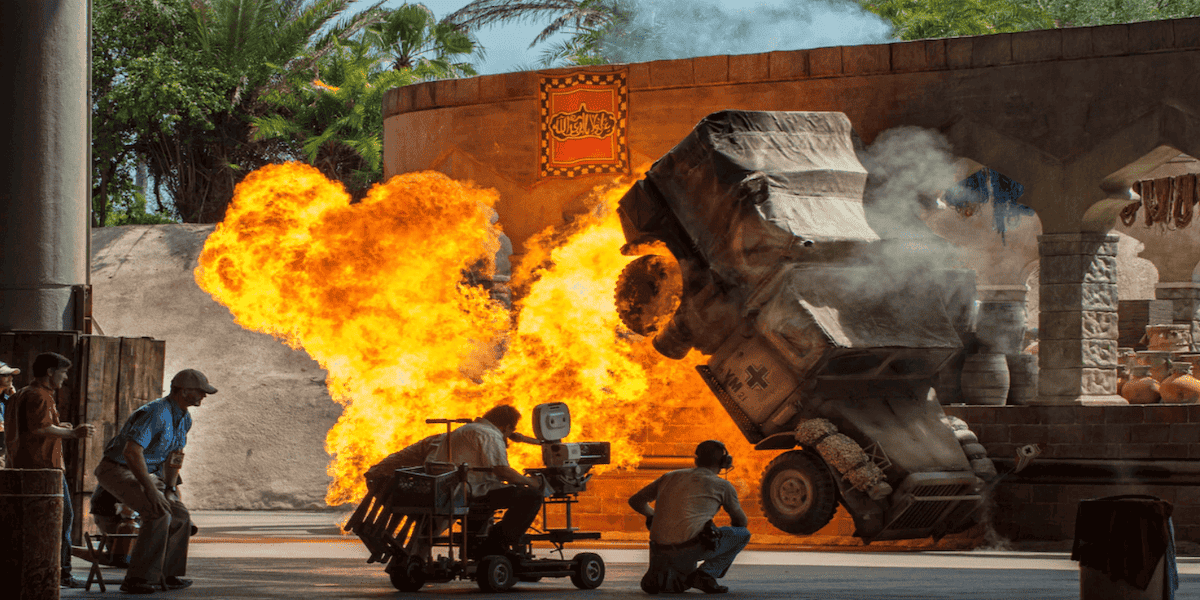
Now, Disney has confirmed a major change to the Indiana Jones Epic Stunt Spectacular! at Disney’s Hollywood Studios. The iconic rolling boulder — one of the most recognizable elements of the show — has been suspended from performances following a Cast Member injury.
To be clear: the show itself has not been suspended. Performances are continuing. Guests are still filing into the theater. Stunt performers are still leaping, fighting, and recreating cinematic chaos.
But the boulder is gone.
And its absence says far more than its removal might initially suggest.
When the Familiar Suddenly Turns Unpredictable
For years, the Indiana Jones stunt show has been one of those experiences guests trust without thinking twice. It’s loud. It’s explosive. It looks dangerous — but it’s also carefully narrated, almost reassuringly so. The show literally explains how movie stunts are performed safely while they’re happening.
That’s what made this incident so jarring.
NEW: During Indiana Jones Epic Stunt Spectacular! at Disney’s Hollywood Studios today, a 400-pound boulder prop dislodged from its track. A Cast Member was injured stopping it before it reached the audience. Disney says the Cast Member received immediate care and is recovering. pic.twitter.com/TxbWYV25OX
— Scott Gustin (@ScottGustin) December 31, 2025
During a live performance, a large boulder prop — estimated to weigh around 400 pounds — became dislodged from its track and began moving beyond its designed stopping point. What was supposed to be a controlled illusion suddenly carried real momentum.
Guests didn’t know that in the moment. They just saw something go wrong.
And then they saw a Cast Member react.
The Split-Second Decision That Changed the Outcome
As the boulder continued forward, one Cast Member stepped in to stop it before it could reach the audience. That Cast Member, later identified by friends as Robert, redirected the prop away from guests.
It wasn’t choreographed. It wasn’t planned. It wasn’t part of the show.
It was instinct.

That instinct likely prevented serious injuries to audience members. But it came at a cost. Robert was injured in the process and required medical treatment, including stitches. He was taken to the hospital and is now recovering.
Online, reactions were immediate and emotional. Friends and fellow Cast Members described him as experienced, calm under pressure, and a former stunt performer — someone uniquely equipped to understand what kind of force he was facing.
Even so, the fact remains: no Cast Member should ever have to physically intervene to stop a moving prop during a Disney show.
Why Disney Removed the Boulder — and Why That Matters
In the days following the incident, guests noticed something different when the show returned.
The boulder sequence was gone.
Instead of the massive rolling prop, the scene now ends with a stunt performer executing a flip before the show moves on. The pacing remains intact, but the visual centerpiece — the moment that draws gasps from first-time viewers — has been removed entirely.

Disney has not publicly detailed how the boulder became dislodged or whether a mechanical failure, wear-and-tear, or another factor was responsible. What is clear is that the company acted quickly to eliminate the risk while internal reviews continue.
Suspending the boulder doesn’t just remove a prop. It removes uncertainty.
Live stunt performances rely on layers of safety — engineering, training, timing, and redundancy. When one of those layers fails, even briefly, the consequences can escalate fast. Removing the boulder ensures that the exact scenario that led to the injury cannot repeat itself while Disney evaluates what went wrong.
Whether this suspension is temporary or permanent remains unknown.
And that unanswered question is part of what’s keeping guests talking.
A Show Built on Trust Faces New Scrutiny
The Indiana Jones Epic Stunt Spectacular has been running for decades. It’s not just popular — it’s dependable. Guests associate its longevity with reliability. It’s one of those shows that feels “solved,” like nothing unexpected could possibly happen anymore.
That perception took a hit.
When technical issues happen backstage or inside ride systems, guests rarely see them. This incident unfolded in full view of an audience. People watched a moment that wasn’t scripted. They watched someone step outside the illusion to prevent something worse.

That visibility changes how incidents are processed emotionally.
The boulder scene, inspired by Raiders of the Lost Ark (1981), is designed to look overwhelming while remaining controlled. When that control slipped, even briefly, it challenged the very premise the show is built on.
Guests weren’t just reminded that stunts are dangerous. They were reminded that safety depends on people, not just systems.
The Human Element Behind the Magic
As attention shifted to the suspended boulder, many fans focused on Robert — the Cast Member who stepped in.
Messages poured in praising his quick thinking and bravery. Some called him a hero. Others expressed concern that any situation existed where such an intervention was necessary at all.
Both reactions stem from the same truth: Disney’s magic relies on real people making real-time decisions.
Cast Members in stunt-heavy roles train extensively, not just to perform but to respond when something goes wrong. Even so, training doesn’t make moments like this routine. It doesn’t erase the risk.
The fact that Robert is recovering is a relief. But his injuries serve as a sobering reminder that live entertainment, no matter how polished, carries real stakes.
What Happens Next Is Still Unclear
Disney has confirmed that its safety teams are reviewing the incident. Beyond that, details remain limited. The company has not stated whether the boulder will return, be redesigned, or be removed permanently.
Historically, changes like this can go either way. Some effects quietly return after modifications. Others disappear entirely, phased out without ceremony.

For now, the boulder’s absence stands as a visible reminder that something went wrong — and that Disney is taking it seriously.
Guests attending the show today may not feel the same rush they once did during that iconic moment. But they may leave with a deeper appreciation for the people behind the scenes — and the split-second decisions that keep audiences safe.
The show goes on.
The boulder does not.
And until Disney says more, the uncertainty surrounding its future continues to roll quietly through a theater that suddenly feels just a little less predictable than it used to.