
 Credit: nick99nack, Flickr
If you’ve ever spent a night watching fireworks over Cinderella Castle, you know how magical an empty sky can feel. No planes dragging advertising banners. No helicopters buzzing overhead. Just the castle, the music, and a sky full of color.
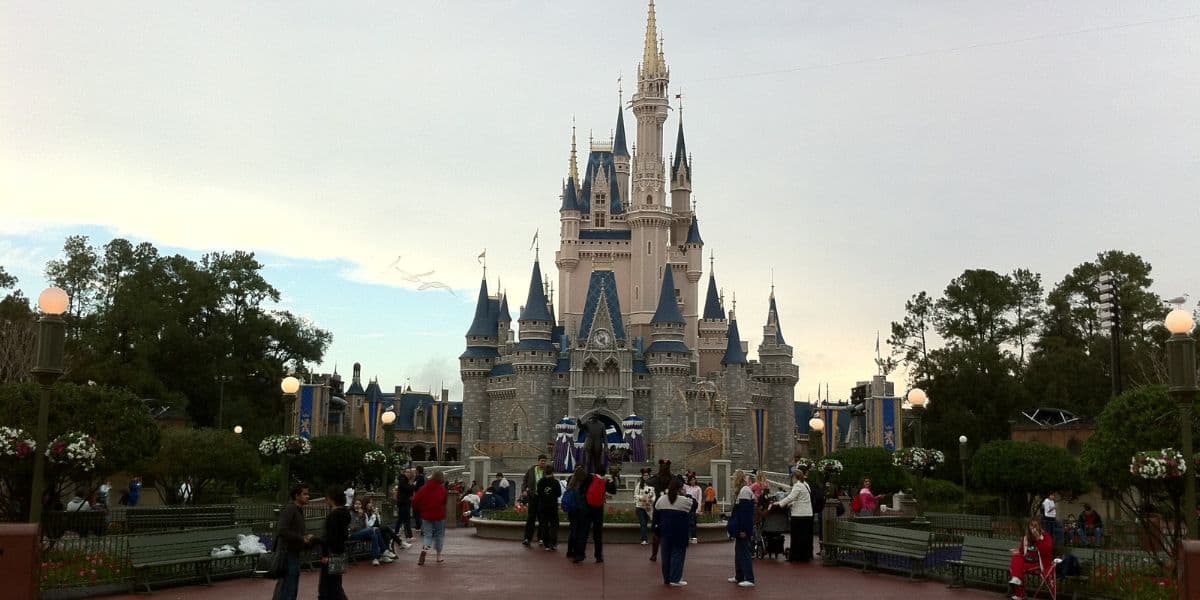
That peaceful airspace has been protected for more than 20 years by a federal flight restriction that keeps most aircraft out of a three-nautical-mile circle around the parks, from the ground up to 3,000 feet. It’s one of the most unusual setups in American aviation, the kind of protection typically reserved for sensitive government sites.
Earlier today, we reported that this restriction had vanished from the Federal Aviation Administration’s public list, leaving fans and pilots wondering whether Disney’s famous no-fly zone had quietly been lifted.
Now there’s an update, and for anyone who loves those uninterrupted castle views, it’s a reassuring one.
Back on the Map
Reporter Scott Gustin shared the update on X. “Update: The TFR is active again and back on the map, this time under a new NOTAM number. It appears the previous NOTAM was replaced, but the restrictions remain identical.”
He followed it with a line that pretty much sums up the whole saga: “We now return you to your regularly scheduled flight patterns.”
Update: The TFR is active again and back on the map, this time under a new NOTAM number. It appears the previous NOTAM was replaced, but the restrictions remain identical.
We now return you to your regularly scheduled flight patterns. https://t.co/W7mpYLCxGv
— Scott Gustin (@ScottGustin) November 10, 2026
In other words, the restriction doesn’t appear to have gone anywhere. The FAA seems to have swapped the old notice for a new one, and the rules themselves are reportedly unchanged.
How the Scare Started
Here’s a quick rewind for anyone just catching up.
Aerial photographer Bioreconstruct was the first to notice the change. According to WDW News Today, NOTAM 4/3634, the notice covering Walt Disney World, dropped off the FAA’s active flight restriction map on November 6. Disneyland’s matching notice, NOTAM 4/3635, disappeared as well.
“The FAA no longer lists the Walt Disney World TFR or Temporary Flight Restriction,” Bioreconstruct wrote. “The no-fly zone that is about a 3 mile radius cylinder 3000 ft tall centered at Contemporary.” Bioreconstruct added that air traffic control at Orlando International Airport said the restriction was still in effect.
BlogMickey later confirmed that both the Walt Disney World and Disneyland entries were missing from the FAA’s list. Even so, pilots near the parks were reportedly still being told to stay out, and the FAA’s own NOTAM detail pages continued to list the restrictions as permanent.
So while the listing vanished, the restriction itself never appeared to stop being enforced.
Wait, What’s a NOTAM?

A NOTAM is one of the FAA’s official notices to pilots. It’s how the agency tells aviators about things like airspace restrictions, and the Disney no-fly zones are published as NOTAMs labeled as temporary flight restrictions with a permanent end date.
Swapping one NOTAM for another isn’t unusual. In fact, it’s happened with Disney’s restriction before. When NOTAM 4/3634 for Walt Disney World took effect in October 2014, the notice itself stated that it replaced an earlier one, NOTAM 9/4985, to reflect a Transportation Security Administration website update and new information about airspace waivers.
The rules spelled out in that notice are pretty specific. Aircraft, including drones and other unmanned or remote-controlled aircraft, can’t fly within the protected area without permission. Exceptions include flights authorized by and in contact with air traffic control for operational or safety reasons, the Department of Defense, law enforcement, and air ambulances.
One more detail many fans don’t realize: at Walt Disney World, the circle is centered near Disney’s Contemporary Resort, and according to WDW News Today, it covers Magic Kingdom and EPCOT, but not Disney’s Hollywood Studios, Disney’s Animal Kingdom, or Disney Springs.
Why This Restriction Exists at All

The Disney no-fly zones trace back to 2003, when Congress required them through a short provision in a federal spending bill. An Orlando Sentinel investigation that year reported that a Disney lobbyist pushed for the language, while Disney said its motivation was guest safety and enjoyment.
The arrangement has drawn questions ever since. In 2013, then-FAA Administrator Michael Huerta told Congress the Disney restrictions would not exist without that law. In 2022 and again in 2023, Rep. Troy Nehls of Texas pushed legislation to remove them, but his bill stalled in a House aviation subcommittee.
That’s why even a disappearing map listing got so much attention this week.
False Alarm, Fireworks Still On
For now, it looks like the no-fly zone was never really gone. The listing went missing, a new notice took its place, and the skies over Magic Kingdom should stay just as quiet as they’ve been for the past two decades.
We’ll keep watching for confirmation on Disneyland’s restriction and any word from the FAA about why the old listing disappeared in the first place.
Okay, be honest. Did this one have you nervous about banner planes buzzing the castle during fireworks? Or were you quietly hoping for a little extra air show? Let us know in the comments. And if you’re a pilot who flies around Orlando or Anaheim, we’d love to hear what you saw on your end this week.