7
7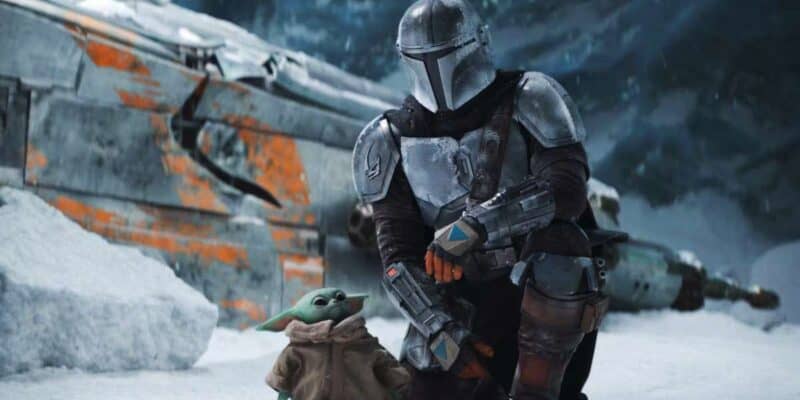
 Credit: Lucasfilm
Disney just dropped a bombshell about its first cinematic Star Wars effort since The Rise of Skywalker (2019).
More than six years after the conclusion of the Skywalker Saga, May will see the box office revisit a galaxy far, far away. The Mandalorian and Grogu (2026), a continuation of the series led by Pedro Pascal, follows the bounty hunter Din Djarin and his apprentice Grogu as they are recruited by the New Republic in the wake of the Galactic Empire’s collapse, with surviving Imperial warlords still posing a threat to the galaxy.

While it’s unclear which narrative threads the film will pick up from the third (and possibly final) season of the Disney+ show, we do know that it will star Sigourney Weaver as Ward (a leader of the New Republic’s Adelphi Rangers), Jeremy Allen White as Rotta the Hutt (son of the iconic antagonist Jabba the Hutt), and Jonny Coyne as an Imperial Warlord.
Some fans have theorized that it will at least partially take place on Hoth, a planet featured prominently in The Empire Strikes Back (1980). While some hope to see a cameo from a young Luke Skywalker (Mark Hamill), we remain somewhat doubtful considering the actor’s stance on reprising the role.
Like the TV series, everything in The Mandalorian and Grogu is overseen by showrunner Jon Favreau, who seems to have pulled off quite the feat for a Star Wars project.
Shockingly Low Budget Revealed for ‘The Mandalorian and Grogu’
According to the California Film Commission, via Collider, Disney spent just $166.4 million making The Mandalorian and Grogu.

We say “just” because the total pales in comparison to other budgets in the franchise’s years under Disney. In terms of the gross production cost before tax credits, Forbes reports that The Rise of Skywalker cost over $590 million, while the lowest budget of any Disney-era Star Wars movie came in at just over $327 million. It spent a whopping $638.9 million on Star Wars: The Force Awakens (2015).
This marks a major pullback for Disney on the Star Wars spending front – which isn’t totally surprising considering the studio’s attitude towards The Mandalorian and Grogu.
Recent reports indicate that Disney views the project as a potential litmus test for the future of Star Wars. With Lucasfilm now under the leadership of co-presidents Dave Filoni and Lynwen Brennan, the studio is said to be watching the performance of The Mandalorian and Grogu closely as it weighs whether to move forward with a previously announced Mandoverse theatrical film.
We’ll have to wait until May to see whether The Mandalorian and Grogu sets the box office alight. However, if ticket sales are as tepid as the response to its Super Bowl trailer, things aren’t exactly looking bright for the future of the Mandoverse.
‘Star Wars’ Attempts to Bounce Back After Years of Struggles
Notably, recent years have come with several struggles within the franchise. While The Mandalorian won over fans upon its debut, subsequent projects have struggled to attract the same level of acclaim. The likes of The Acolyte, The Book of Boba Fett, and Skeleton Crew have been met with mixed to negative responses.

In the case of The Acolyte, fan reception was, at times, overwhelmingly negative. Showrunner Leslye Headland has since commented on the response, pinning it in no small part on “fascists and racists.”
Ultimately, when Disney cancelled the show, it attributed the decision to its high budget. As per Forbes, production of The Acolyte set Disney back an eye-watering $230.8 million (although it did take home a tax credit of $43.8 million).
“We were happy with our performance, but it wasn’t where we needed it to be, given the cost structure of that title, quite frankly, to go and make a season two,” Alan Bergman, co-chairman of Disney Entertainment, told Vulture in 2024. “So that’s the reason why we didn’t do that.”
It similarly spent the big bucks on Andor. While often regarded as one of the best projects under the Disney Star Wars banner, the budget for the two-season show ballooned to $645 million (via Forbes).
That context makes the $166.4 million budget more significant. After years of projects routinely clearing the $300 million mark, Disney appears to be pulling back from its big-budget, no-holds-barred Star Wars era and instead focusing on smaller projects – starting with The Mandalorian and Grogu.

Its approach extends beyond one film. A recent New York Times profile of Shawn Levy, director of the upcoming Star Wars: Starfighter (2027), emphasized his reputation for discipline. Hugh Jackman described Levy as “never over time, over budget, over schedule.”
Taken together, the signals point toward a broader shift. Star Wars is no longer operating under an assumption of limitless spending. After uneven streaming results and costly experiments, Disney appears intent on tightening the margins.
The era of unchecked Star Wars budgets may not be entirely over, but it is clearly being reassessed — and the days of Skywalker Saga–level spending may soon feel like a relic from a galaxy far, far away.
Are you excited for The Mandalorian & Grogu?