5
5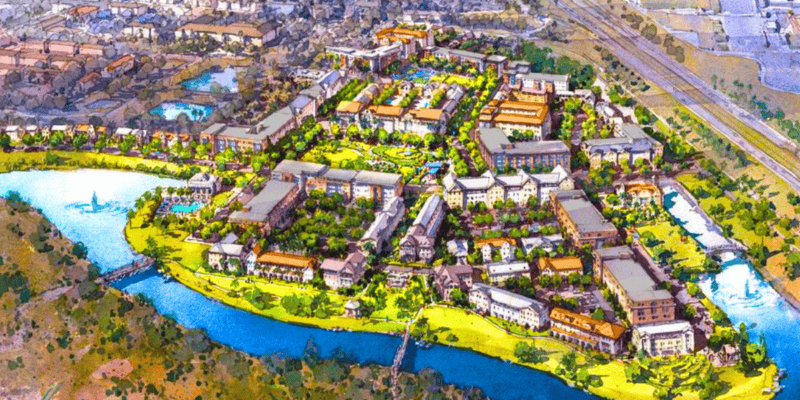
 Credit: Disney
Walt Disney World has always promised something more than rides and fireworks. For generations, guests have traveled to Central Florida expecting not just escapism, but a carefully crafted world where fantasy and reality meet in carefully controlled harmony.
Yet beyond the berm, beyond the carefully manicured gates and themed skylines, Disney’s presence in Florida has always carried weight far beyond entertainment. Roads, hotels, neighborhoods, and even entire governing districts have risen alongside the resort’s growth. And for many longtime residents, that growth has been both a blessing and a burden.
In recent years, conversations around housing, affordability, and the future of Central Florida have grown louder. Fans have noticed Cast Members commuting longer distances. Locals have watched rents climb. And Disney, often viewed as the region’s largest cultural anchor, has quietly been preparing to step into a space few expected.
What began as a hopeful announcement years ago soon became one of the most controversial development efforts tied to Walt Disney World in decades.

A Promise That Sounded Simple on Paper
When Walt Disney World first spoke about giving back through housing, the idea felt almost poetic. Affordable homes, thoughtfully designed, near the place that employs tens of thousands — it sounded like a natural extension of Disney’s long-standing presence in Central Florida.
Concept art shared in early phases showed peaceful neighborhoods, tree-lined walkways, and a community that blended seamlessly into the area near Flamingo Crossings. Disney emphasized that the project would not be a profit venture, but a contribution — land donated, design provided, and no direct financial return.
For many fans, this felt like Disney stepping into a leadership role beyond entertainment.
But almost immediately, not everyone was convinced.

Resistance Builds as the Plan Takes Shape
As details emerged, opposition followed quickly. Nearby residents raised concerns about density, traffic, infrastructure strain, and how such a large development might change the character of the surrounding area. Public meetings grew tense. Planning sessions stretched late into the night.
By the time rezoning requests reached Orange County officials, the project had become a lightning rod.
In February 2024, new concept art and income ranges reignited debate. The Planning and Zoning Commission narrowly approved the project by a 4–3 margin, reflecting how divided the community had become. A month later, the Board of County Commissioners faced packed chambers as residents again voiced concerns.
The vote passed — 4–2 — but the victory felt fragile.
Behind the scenes, more hurdles remained.

A Project That Wouldn’t Break Ground
Even after zoning approval arrived in October 2024, the dirt remained untouched. Groundbreaking dates slipped quietly from late 2024 into 2025, and then further into uncertainty.
Inside the Magic reported in mid-2025 that construction still had not been approved, despite the green light from county and state officials months earlier. By fall, industry watchers began to accept what many suspected: this project would not begin until 2026 — at the earliest.
Online, fans began speculating.
On X (formerly Twitter), some questioned whether Disney had quietly shelved the idea. On Reddit, Cast Members debated whether the homes would ever materialize — and whether they would truly be affordable if they did.
By the start of 2026, the project’s own website still listed a 2025 groundbreaking that had long since passed.
And then, quietly, a final decision arrived.

The Final Approval That Changes Everything
In January 2026, the State of Florida’s water management district issued its long-awaited approval, clearing one of the final regulatory hurdles standing between Disney and construction.
It may sound technical — but this was the missing piece.
With water management permits now secured, Walt Disney World finally has the authority to begin building on land north of Flamingo Crossings that was once used for defunct water basins. For the first time in nearly four years, the project is no longer stalled by red tape.
The development will include approximately 1,400 mixed-income units, with more than 1,000 reserved as affordable housing. Updated plans show 1,369 total units built in five phases, featuring a mix of one- to four-bedroom apartments.
More than 600 will be one-bedroom units, while over 700 will accommodate families. Buildings will rise up to five stories tall — a noticeable change to the surrounding landscape.
And while Cast Members will be eligible, the apartments will be open to any qualified residents.

What This Means for Cast Members and the Community
Disney has previously stated that most affordable units will target households earning around 80% of the Area Median Income — roughly $49,000 to nearly $90,000 annually. Only a small percentage will be reserved for families at the lowest income levels.
That detail has already sparked renewed debate online.
Some fans applaud Disney for stepping into the housing crisis at all, calling it a long-overdue move. Others argue the income ranges leave out the very workers who need housing the most.
Still, Disney maintains it will not profit from the project. The company donated the land and provided design support, framing the community as a long-term investment in Central Florida — not in revenue.
If construction begins this year, the first residents likely won’t move in until 2027 or even 2028. A full buildout could take five years.
For now, the magic remains theoretical.
But after years of delays, votes, and controversy, one thing is finally clear: the project is no longer stuck in limbo.
And the future of housing near Walt Disney World is about to change.