
 Credit: Disney
The final weekend of June 2026 has brought a seismic shift in how guests navigate the Walt Disney World property. For decades, one of the most cherished subcultures of the Disney fandom was “resort hopping”—the casual, spontaneous art of visiting Disney’s intricately themed deluxe hotels to shop, soak in the atmosphere, and sample iconic snacks.
However, an invisible, highly advanced digital wall is quietly being erected around these properties.
As a controversial transit restriction prepares to go live tomorrow, Sunday, June 28, 2026, tech-savvy fans have discovered that Walt Disney World is now using mobile geo-tracking software in the My Disney Experience app to block offsite guests from using popular backdoors into the resorts. The combination of digital location tracking and physical gatekeeping signals a clear and definitive end to the unrestricted, spontaneous Disney day.
The App Error Heard ‘Round the Internet
The realization that Disney had upgraded its digital defenses crystallized following a viral social media post on X (formerly Twitter) by user @CoasterK24. The user posted a screenshot exposing an aggressive new distance barrier embedded within the My Disney Experience app’s mobile food and beverage ordering interface.
According to the online report, when a guest attempts to place a mobile order for a resort quick-service dining location while physically located far outside that resort’s immediate geographic footprint, the app throws a hard error. Instead of processing the payment and assigning a pickup window, the system locks the transaction and informs the user that they are too far from the venue to place an order.
This discovery confirms that Disney is leveraging real-time GPS and cellular geo-tracking to map user proximity before granting access to transactional services. What appears to be a minor software update is, in reality, a targeted strike against a decades-old parking workaround used by offsite tourists, budget travel hackers, and local Annual Passholders.
The Catch-22: How Geo-Tracking Locks the Parking Gates
To understand why this geo-tracking feature has caused such a massive uproar, one must look at how parking security operates at Walt Disney World’s premier hotels. Properties along the Monorail loop (such as the Contemporary, Polynesian, and Grand Floridian) and the EPCOT resort area are plagued by severe parking overcrowding due to their proximity to the theme parks.
To prevent day-trippers from using hotel lots to dodge the standard $35 theme park parking fee, security guards at the resort entrance shacks strictly turn away vehicles unless the driver can prove they have a legitimate reason to be there.
Historically, showing a confirmed hotel stay or an Advance Dining Reservation (ADR) for a sit-down restaurant was the standard ticket past the security gate.
However, clever guests discovered a flawless loophole: they would park their car on the shoulder near the resort, open the My Disney Experience app, place a quick mobile order for a cheap item—like a cup of coffee or a pastry—at the resort’s quick-service counter, and drive up to the guard shack. Upon showing the mobile order screen to the security guard, the gate would lift, granting the vehicle up to three hours of complimentary resort parking.
By introducing geo-fenced distance restrictions on mobile ordering, Disney has constructed a brilliant, inescapable corporate trap.

Because the app actively blocks you from placing an order until your phone’s GPS places you within the immediate resort zone, you can no longer pre-order from your car down the road. The digital gate locks out the physical vehicle, effectively locking down the resort parking infrastructure for anyone who isn’t an official overnight guest or holding an expensive table-service reservation.
Taking Effect Tomorrow: The Disney Springs Transit Purge
The implementation of mobile geo-tracking does not exist in a vacuum. It is the final piece of a coordinated, property-wide effort to restrict resort access to paying, on-property guests. The most overt display of this lockdown arrives tomorrow, Sunday, June 28, 2026, at the Disney Springs bus depots and water taxi launches.
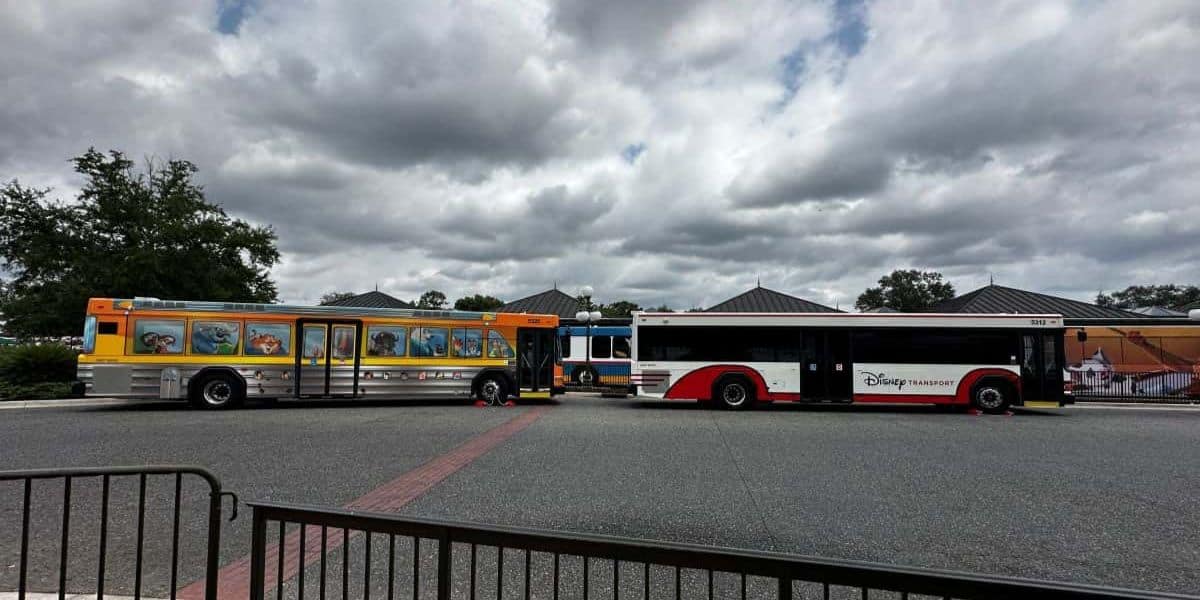
Following successful test windows during peak holiday corridors earlier this year, Disney is permanently altering its complimentary transit model out of its flagship shopping district. Starting Sunday morning, guest relations Cast Members armed with handheld scanning tablets will be stationed at the entrances of all resort-bound bus queues and the Sassagoula River Cruise docks.
Before entering a physical transit line, every guest must scan their MagicBand, Key to the World card, or present their My Disney Experience digital pass. To clear the checkpoint and board the vehicle, the automated scan must actively verify that the guest possesses at least one of the following same-day credentials:
- An active reservation at a registered Walt Disney World Resort hotel.
- A confirmed Advance Dining Reservation (ADR) at the destination resort.
- A confirmed booking for an eligible Enchanting Extras experience hosted at that hotel.
To make the policy completely airtight, Disney is enforcing a strict two-hour transit window. If you hold a dining reservation for a 7:00 p.m. dinner at a resort, your digital profile will actively block you from passing the Disney Springs bus security checkpoint until 5:00 p.m. at the earliest. offsite visitors will no longer be allowed to use Disney Springs as a free parking terminal to spend the entire afternoon roaming the hotel properties unchecked.
The Casualties of Gated Logistics
While these dual digital and physical blockades are highly effective at optimizing crowd control and capturing lost parking revenue, the collateral damage to innocent, well-meaning park-goers is devastating. The absolute biggest victims of this structural shift are Disney World’s world-class hotel lounges and walk-up bakeries.
Fan-favorite destinations like the Tambu Lounge or the highly elusive Trader Sam’s Grog Grotto at the Polynesian, Scat Cat’s Club (famous for its hot Mickey beignets) at Port Orleans French Quarter, and the River Roost Lounge at Riverside operate strictly on a walk-up, first-come, first-served basis.
Because these casual lounges and quick-service spots do not accept traditional Advance Dining Reservations, they are fundamentally incapable of generating the specific digital confirmation codes required to clear the new Sunday security checkpoints or bypass a parking guard shack.

Under the late June 2026 operational rules, an offsite family or a local Annual Passholder who simply wants to take a casual evening boat ride from Disney Springs to grab some specialty beignets is completely blocked from doing so.
Unless you pay for parking at a major theme park or the Transportation and Ticket Center (TTC) and travel across the internal monorail or watercraft lines—which remain unrestricted for now—the casual amenities of Disney’s resorts have effectively been paywalled behind a premium room night.
The New Corporate Reality
Ultimately, the fury exploding across online fan forums highlights a growing cultural divide between Disney’s corporate efficiency goals and the desires of its loyal, offsite fans. Disney is a data-driven enterprise that must protect its most premium assets.
When a guest shells out upward of $700 to $1,000 a night to stay at a flagship property like the Grand Floridian, they expect available parking spaces, open tables at the quick-service counters, and uncrowded transportation lines.

By using cutting-edge fencing software to suffocate parking loopholes and deploying casting nets at transit hubs, Disney is drawing a clear, uncompromising boundary line; the message from Burbank is unmistakable: the internal resort infrastructure belongs to the on-property consumer. As the digital checkpoints drop across property this Sunday, the era of the spontaneous, budget-friendly “free” Disney resort day officially fades into theme park history.