Credit: Disney
There is a version of corporate sustainability that lives entirely in press releases. Lofty pledges, distant deadlines, glossy renderings of solar panels on rooftops nobody ever sees. Disney, for all of its scale and spectacle, has been doing something a little different lately. Quietly, and with a level of detail that tends to get lost in the Earth Month noise, the company has been weaving its environmental commitments into the daily lives of the people who actually run the parks: its cast members. Not as a footnote. Not as a feel-good sidebar. But as the actual engine of the effort.
That shift matters. Disney World alone employs tens of thousands of cast members across its Florida resort. When the people who greet guests at park gates, serve food in themed restaurants, and operate beloved attractions become part of an environmental system, the impact ceases to be theoretical. It becomes embedded in the operation itself. And the more you look at what Disney has been building over the past few years, the clearer it becomes that cast members are not just participants in the company’s green goals. They are, in many ways, the whole point.
How Disney is Making Cast Member Costumes More Environmentally Friendlyhttps://t.co/1QX1Qx6coI
— WDW News Today (@WDWNT) April 14, 2026
It Starts With What They Wear
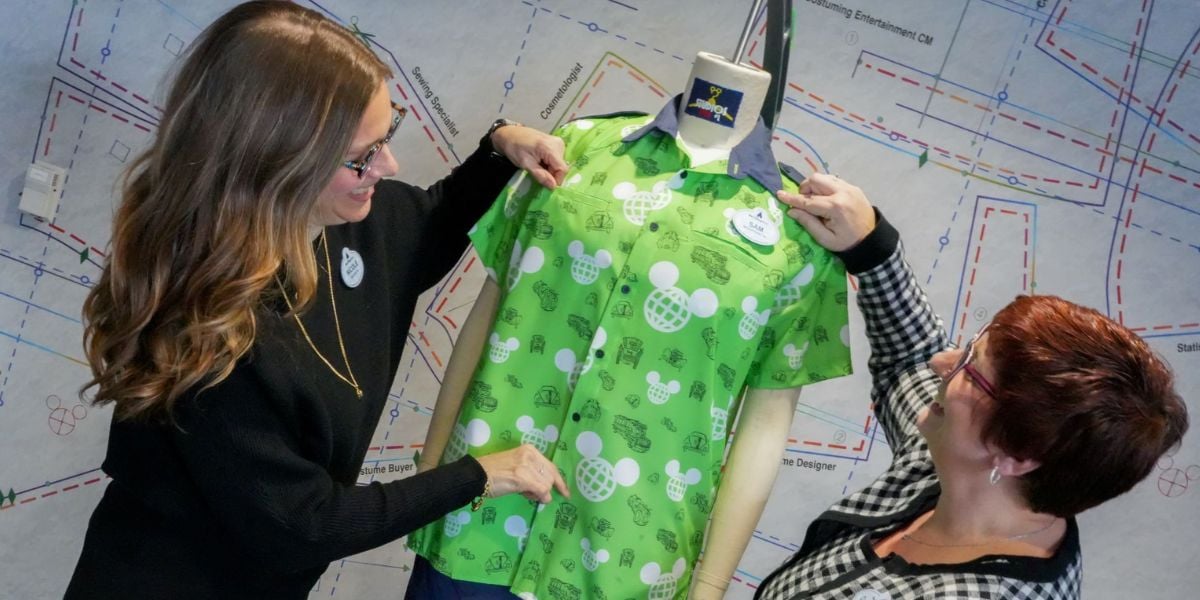
The most prominent aspect of this strategy is the costume program. In honor of Earth Month, Disney recently announced that 20 percent of the materials used in cast member costumes are now made from recycled components. This shift represents a significant commitment to sustainability across a wardrobe that encompasses thousands of roles, parks, and climates. However, the redesigns are not only focused on sustainability; they also incorporate updated fabric technology. This new technology makes the costumes lighter, more moisture-resistant, and provides better sun protection. These practical upgrades improve working conditions for cast members who work long outdoor shifts, especially at places like Walt Disney World, where the summer heat can be intense.
The choice to tie environmental progress to cast member comfort is deliberate. It means the people wearing these costumes have a reason to care about the program beyond policy. When sustainability improves the actual experience of doing your job, it becomes personal.
What Happens When Disney Retires Costumes
The more ambitious aspect of Disney’s costume program involves what happens after the garments are no longer worn. Instead of considering retired costumes as waste, Disney has established a multi-layered system to extend their lifespan.
At Walt Disney World, components like rain gear and sneakers are evaluated for recycling rather than disposal. The Cosmetology team alone has recycled over one million bobby pins to date, a detail that sounds small until you think about the sheer volume of daily operations that number represents. These are the quiet accumulations of a system that takes the end-of-life question seriously.

Disneyland Paris has adopted a creative approach to sustainability. Costumes that can no longer be worn are transformed into felt insulation, which is then donated to local organizations for use in construction projects. In total, nearly 15 tons of costumes, comprising around 33,000 pieces, were processed in 2023 and 2024. This material does not go to waste; instead, it becomes a valuable resource for the community surrounding the park.
Tokyo Disney Resort approached the problem from a completely different angle. Through the Circulating Smiles initiative, guests can purchase limited-edition merchandise made from retired cast member costumes. Patch badges, tote bags, and pouches have been created using fabric from Big Thunder Mountain costumes, Buzz Lightyear’s Astro Blasters uniforms, and clothing worn by cast members at the Pooh Corner shop. The initiative creates a direct, tangible connection between guests and the people who serve them, with sustainability as the thread running through it.
Why the Disney Cast Member Focus Is the Right One
Building environmental programs around cast members is a strategic choice that goes beyond mere appearances. Cast members are the most consistent human presence across all Disney park experiences. They engage with guests, manage resources, and maintain the resort’s physical environment day in and day out. If Disney aims for its sustainability commitments to endure, it must integrate these principles into the workflows, uniforms, and culture of its cast members. This integration ensures that the commitments last well beyond a single Earth Month campaign.

The costume program is one visible layer of that. But it points toward a broader operating philosophy: that the people closest to the guest experience are also the people best positioned to carry the environmental mission forward. Disney’s pollinator programs, its conservation work at Animal Kingdom, and its broader net-zero targets all depend on a workforce that is not just following instructions but working within systems designed to make responsible choices the default.
That is what makes the cast member angle worth paying attention to. It is not about any one initiative. It is about where Disney has chosen to root the work.