
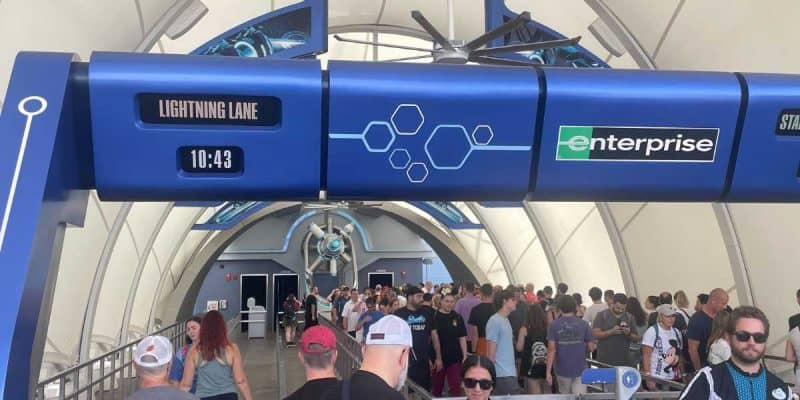
 Credit: Inside the Magic
While social media is flooded with complaints about “nickel and diming,” the internal data from Walt Disney World tells a very different story.
As the 2026 Spring Break season ramps up, Lightning Lane Premier Pass has quietly become one of the most in-demand offerings on property. And not just in a casual way—it’s consistently selling out at Magic Kingdom at a jaw-dropping $449 per person.
That number alone should raise eyebrows. For many guests, it’s more than the cost of a single park ticket. Yet despite the backlash, frustration, and endless online debates, guests are still buying in. Not hesitating. Not waiting. They’re logging in right at 7:00 a.m. and grabbing it before it disappears.
So the big question becomes unavoidable: Is Disney pushing the limits of what guests will tolerate, or have they actually cracked the code?
The “Express Lane” Disney Said It Wouldn’t Bring Back
For years, Disney avoided anything that resembled a traditional “skip-the-line” system tied directly to high pricing. FastPass was free. Even early iterations of paid systems felt like a softer approach.
That’s no longer the case.
Since the major overhaul in late 2024, the Genie+ name has been retired, and in its place is a fully tiered Lightning Lane system that essentially allows guests to decide how much they want to pay to avoid standby lines altogether.
At the center of that system is the Premier Pass.
This is Disney’s closest version yet to an “Express Lane.” No return windows. No juggling times. No waking up early to strategize every move. You simply walk up to any Lightning Lane entrance in a park and ride.
It’s simple. It’s powerful. And it’s expensive.
Breaking Down the Three-Tier System
To really understand why Premier Pass is selling out, you have to look at the broader system Disney has built around it.
The entry-level option is Lightning Lane Multi Pass. This replaced Genie+ and allows guests to pre-book three attractions in a single park before arrival. Prices fluctuate between $22 and $45+, depending on demand. Once you scan into your first ride, you can continue booking throughout the day.
Then there’s Lightning Lane Single Pass. This is the pay-per-ride option for the most in-demand attractions—think TRON Lightcycle / Run or Guardians of the Galaxy: Cosmic Rewind. Guests can purchase up to two of these per day, typically ranging from $13 to $25 per ride.
And finally, Premier Pass sits at the top.
It bundles everything together. Every Lightning Lane. One time per ride. No scheduling. No restrictions beyond availability. Pricing ranges from $119 on slower days to a peak of $449 during high-demand periods like Spring Break.
That last number is what’s turning heads—but it’s also what’s selling out.
The Power of “No Planning”
If you’ve visited Walt Disney World recently, you know how much planning goes into a successful park day.
You’re thinking about rope drop strategy. You’re watching wait times. You’re juggling dining reservations. And if you’re using Multi Pass, you’re constantly refreshing your phone to grab the next available return window.
Premier Pass removes all of that.
There’s no pressure to optimize. No fear of missing out on a key attraction. No need to prioritize one ride over another early in the day. You just show up and move at your own pace.
For a certain type of guest—especially families visiting for a once-in-a-lifetime trip—that simplicity has real value.
And clearly, enough value to justify the price.
The “7 and 3” Rule Is Quietly Driving Demand
Another factor pushing guests toward higher-priced options is Disney’s booking window advantage.
Resort guests can book Lightning Lane selections seven days before their trip, covering their entire stay (up to 14 days). Off-property guests, on the other hand, only get access three days before their visit.
That four-day gap is massive.
By the time many off-property guests log in, the most desirable Tier 1 attractions are already gone. That includes rides like Tiana’s Bayou Adventure at Magic Kingdom or Slinky Dog Dash at Hollywood Studios.
For those guests, Premier Pass becomes less of a luxury and more of a workaround.
Instead of fighting for limited availability, they can bypass the system entirely.
Tier Restrictions Add to the Pressure
Even within Multi Pass, Disney has introduced another layer of complexity with its tiered attraction system.
When making your initial three selections, you can only choose one Tier 1 attraction. The remaining two must come from Tier 2.
That means you can’t stack your day with the biggest rides right away. You have to wait until you scan into your first attraction before unlocking full flexibility.
It’s not a dealbreaker—but it adds friction.
And every bit of friction makes the Premier Pass look more appealing.
Because with that option, none of those rules apply.

The Sell-Out Streak That Says Everything
Here’s where things get really interesting.
Despite the pricing, despite the online criticism, and despite the perception that Disney is charging more than ever… Premier Pass continues to sell out.
Not occasionally. Consistently.
Magic Kingdom has seen repeated sellouts during peak travel weeks. EPCOT and Hollywood Studios are following closely behind. And with Easter approaching, demand is only expected to climb higher.
That tells you something important.
There is a segment of Disney guests who are not just willing to pay for convenience—they’re prioritizing it above everything else.
A Redefined Park Experience
What we’re seeing in 2026 isn’t just a pricing shift. It’s a structural change in how guests experience Walt Disney World.
There are now clearly defined tiers of access.
At the base level, you have standby guests navigating long waits and unpredictable days.
In the middle, Multi Pass users are optimizing, planning, and working the system.
And at the top, Premier Pass users are moving freely, with minimal friction and maximum flexibility.
It’s a very different dynamic than what Disney offered even five years ago.
And whether that feels like innovation or exclusion depends entirely on where you fall within that system.
Genius or Something Else?
Disney has always been a company that tests boundaries.
From ticket pricing to hotel perks to park expansions, the strategy has often been to push forward and adjust based on guest response.
Right now, the response is clear.
People are buying.
That doesn’t mean the criticism is wrong. It doesn’t mean guests are happy about paying more. But it does mean the model is working—at least from a business standpoint.
The real question is what happens next.
If demand continues at this level, does Disney push the ceiling even higher? Does Premier Pass become the new normal for peak travel periods? Or does guest fatigue eventually catch up?
For now, though, the results are in.
And whether you call it genius or greed, Disney’s version of an “Express Lane” isn’t just back—it’s thriving.