
 Credit: Disney
At first glance, this looks like a simple operational tweak. Smugglers Run now offers a Double Rider queue in addition to its existing Single Rider option. But once you start peeling back the layers, it becomes clear this change taps into something deeper than just line management. It touches how people experience the attraction emotionally, how they negotiate group dynamics, and how Disney continues experimenting with crowd flow in ways that rarely get explained upfront.
Because this isn’t just about saving time.
It’s about control — or at least the illusion of it.
The Ride That’s Always Been About Roles
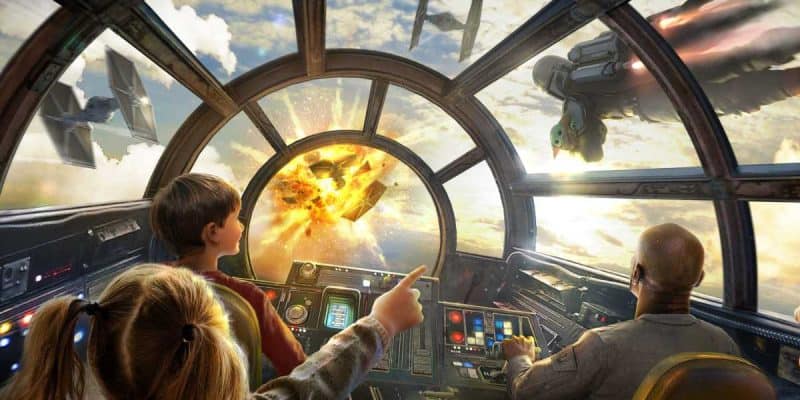
Smugglers Run has always stood apart from most attractions because riders don’t just sit and watch; they participate. Pilots steer. Gunners fire. Engineers scramble to keep the ship together. Every seat carries a different level of engagement, and over the years, guests have developed strong preferences. Some crave the chaos of piloting. Others enjoy the pressure of keeping systems functioning from the back row.
That dynamic has always created quiet negotiations in line. Families strategize. Friends bargain. Parents promise kids the pilot seat “next time.” Even before boarding, the ride has always had this layer of anticipation humming beneath the surface.
Introducing a Double Rider queue drops a new variable into that equation.
Now, two guests can enter knowing they’ll likely stay together without committing to the longer standby wait. But there’s still uncertainty baked in. Will they land pilot positions? Engineers? Something in between? The new queue offers togetherness, but not certainty. And that tension changes how people approach the experience before they ever step into the cockpit.
A Quiet Change That Says a Lot
Disney didn’t roll this out with fanfare, but the presence of a Double Rider line signals something important. It suggests Smugglers Run continues evolving operationally years after opening. Attractions rarely stay static, especially ones built around variable rider roles, and this move feels like Disney fine-tuning how efficiently seats are filled without sacrificing too much guest satisfaction.
The update was first noticed by guests and shared online, confirming that this isn’t theoretical—it’s already in place.
Millennium Falcon: Smugglers Run now has a Double Rider queue (in addition to Single Rider) at #Disneyland. #GalaxysEdge pic.twitter.com/3X0HagOiyY
— LaughingPlace.com (@laughingplace) January 28, 2026
Still, what makes this intriguing isn’t just the added option. It’s the questions it raises.
Is this a test for broader changes? Could other role-based attractions see similar adjustments? Or is this simply Disney reacting to specific traffic patterns unique to Smugglers Run?
Right now, there’s no official roadmap explaining where this leads.
The Emotional Side of “Skipping the Line”
Single Rider queues have always carried a trade-off: speed in exchange for separation. You move faster, but you accept losing control over who you sit with and what role you’ll get. For many guests, that’s an easy decision. For others, it undermines the shared experience they traveled to have.
The Double Rider queue feels like Disney acknowledging that middle ground exists. Not everyone wants the full standby commitment, but they’re also unwilling to gamble on total separation. This option quietly recognizes that emotional priorities don’t always align with operational efficiency.
And yet, it doesn’t remove all tension.
You might still board without ideal roles. You might still watch another group take pilot seats while you slide into engineering. The difference now is that at least you’re navigating that uncertainty together. For some guests, that shared unpredictability is part of the fun. For others, it may introduce a new kind of hesitation before choosing which line to join.
Why This Matters More Than It Seems
Theme park operations often appear mechanical from the outside, but they’re deeply psychological. Every queue decision involves expectations, perceived fairness, and personal priorities. Smugglers Run has always been uniquely sensitive to those factors because the ride outcome varies based on rider actions.
Adding a Double Rider queue subtly reshapes guest psychology. Suddenly, the choice isn’t just “long wait together” or “short wait apart.” There’s now a third path that promises partial control without guaranteeing outcomes.
That gray area can be both exciting and unsettling.
Guests who thrive on spontaneity might embrace it. Others who prefer predictable experiences could find themselves hesitating longer at the entrance, weighing options instead of committing quickly. Ironically, a change meant to streamline flow might introduce new layers of indecision.
A Sign of Broader Experiments?
Disney has always used certain attractions as testing grounds for operational ideas. Smugglers Run, with its flexible seating and variable roles, naturally lends itself to experimentation. The introduction of a Double Rider queue suggests the company continues exploring how far they can refine capacity without diminishing the magic.

But what remains unclear is whether this is a localized adjustment or part of a larger strategy. Could we see variations of multi-rider lines elsewhere? Will guest feedback shape how permanent this becomes?
At this stage, Disney hasn’t said.
And that silence leaves space for speculation to grow.
The Falcon Keeps Evolving
For an attraction centered around flying the fastest hunk of junk in the galaxy, Smugglers Run has proven surprisingly adaptable. From virtual score variations to evolving queue strategies, it hasn’t stayed frozen in time. This latest adjustment continues that pattern, showing that even established rides can shift beneath guests’ feet.
The emotional ripple effect may take time to fully reveal itself. Some visitors will appreciate the added flexibility immediately. Others might find it complicates what used to be a straightforward decision. Either way, it adds another layer to how people experience Galaxy’s Edge — one that blends anticipation with uncertainty.
And maybe that’s fitting.
After all, stepping onto the Falcon has never been about guarantees. It’s about taking the seat you’re given, making the most of the moment, and hoping the jump to lightspeed goes smoothly.
Now, with the Double Rider queue in play, that spirit of unpredictability starts even earlier — before the boarding doors open, before the roles are assigned, before anyone knows exactly how their flight will unfold.
And for many guests, that lingering question might just make the experience feel a little more alive than ever.