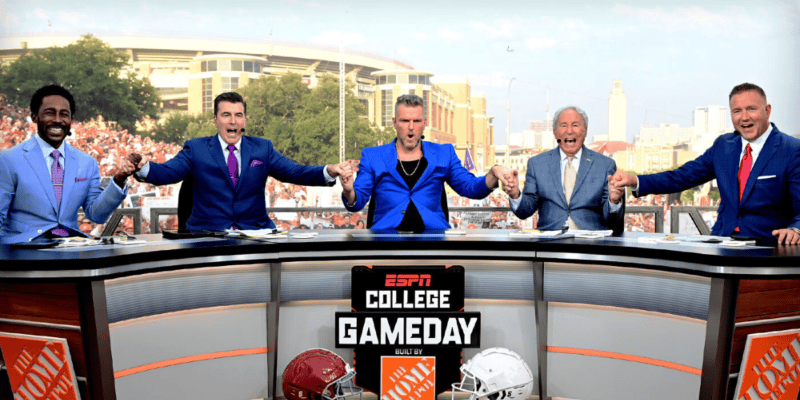
 Credit: ESPN
The Walt Disney Company finds itself at the center of a political and media controversy after sports fans and media critics questioned the entertainment giant’s handling of two politically related television appearances. On Saturday, September 12, 2026, Disney-owned ESPN gave conservative Senator Ted Cruz (R-TX) nearly 10 minutes of airtime during its flagship program, College GameDay, live from Austin, Texas.
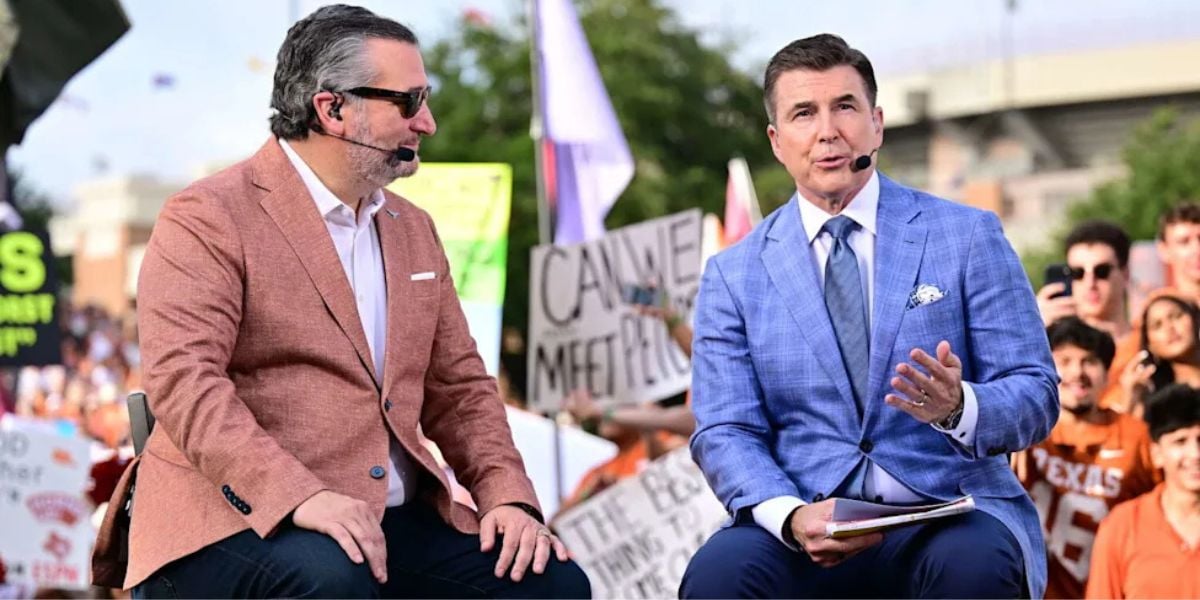
The segment—which featured Cruz promoting his college sports legislation while being drowned out by a chorus of angry fan boos—came just days after sister network ABC moved late-night host Jimmy Kimmel’s TV interview with Democratic Texas Senate candidate James Talarico from broadcast television to YouTube amid concerns Kimmel said were related to regulatory scrutiny from the Federal Communications Commission (FCC).
The contrasting treatment has drawn criticism from some sports media commentators and social media users, who have questioned how Disney handled the two appearances across its television platforms.
Booed in Austin: Ted Cruz Takes the Mic on ESPN’s College GameDay
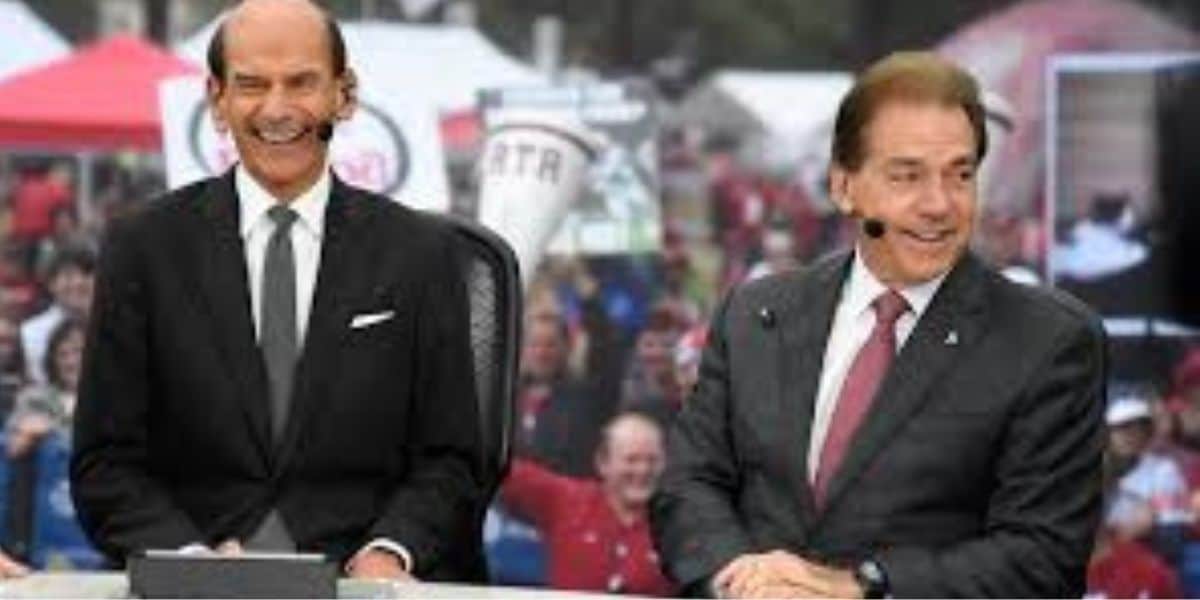
The controversy reached a boiling point during the September 12 broadcast of College GameDay, broadcast live from the University of Texas at Austin campus ahead of the highly anticipated Texas vs. Ohio State football matchup.
Host Rece Davis brought Senator Ted Cruz onto the main desk for a roughly nine-minute interview segment to discuss Cruz’s proposed “Protect College Sports Act of 2026.” The bill aims to establish a federal framework for college-athlete Name, Image, and Likeness (NIL) rights while creating antitrust exemptions involving college athletics, including provisions concerning eligibility, NIL rules, and the pooling and sale of media rights by conferences and institutions.
“Most college athletic programs are losing tens of millions of dollars… If we don’t act, in three to five years we’re going to see 40 to 50 schools that have competitive football programs and everyone else goes under,” Cruz claimed during the broadcast.
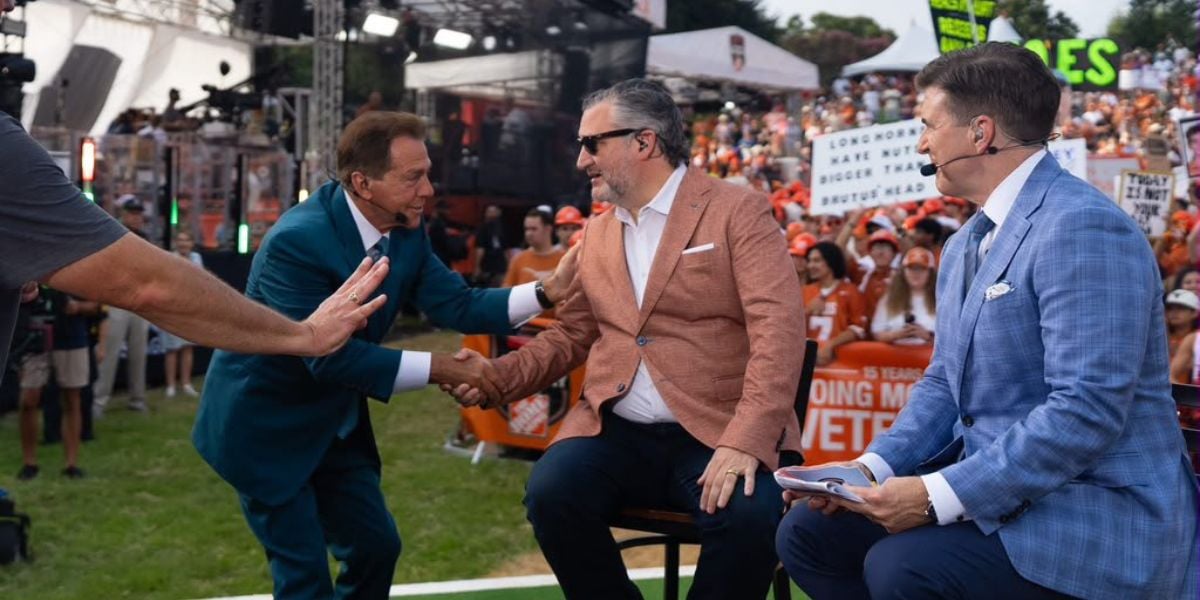
However, the crowd of college football fans standing behind the desk was having none of it. Throughout the segment, fans repeatedly booed Cruz, chanting “Ted, you suck!” and “Get him off,” according to reports from the event.
Sports media critics immediately questioned why ESPN devoted roughly 10 minutes of its premier pregame show to Cruz’s discussion of his legislation, with no opposing lawmaker appearing in the segment. Stewart Mandel of The Athletic publicly asked on X (formerly Twitter): “So GameDay gave a politician 10 minutes to shill for PCSA right before there might be a vote. Was there any thought that maybe someone on the other side of it should get a chance to rebut, or no?”
Benched to YouTube: ABC Moves Jimmy Kimmel’s Interview with James Talarico
What made Cruz’s extended ESPN segment particularly notable was the corporate context unfolding just days prior at ABC, Disney’s broadcast television network.
On Wednesday, September 10, late-night host Jimmy Kimmel informed his audience during Jimmy Kimmel Live! that an upcoming interview with James Talarico—the Democratic candidate running for U.S. Senate in Texas against Republican Attorney General Ken Paxton—would not air on broadcast television and would instead be released exclusively on YouTube.
Kimmel explained on air that the decision was made to protect local ABC affiliate stations from what he described as aggressive enforcement threats by the FCC, led by Chairman Brendan Carr. The FCC has been examining whether certain television programs featuring political candidates qualify for exceptions to federal equal-opportunities requirements.
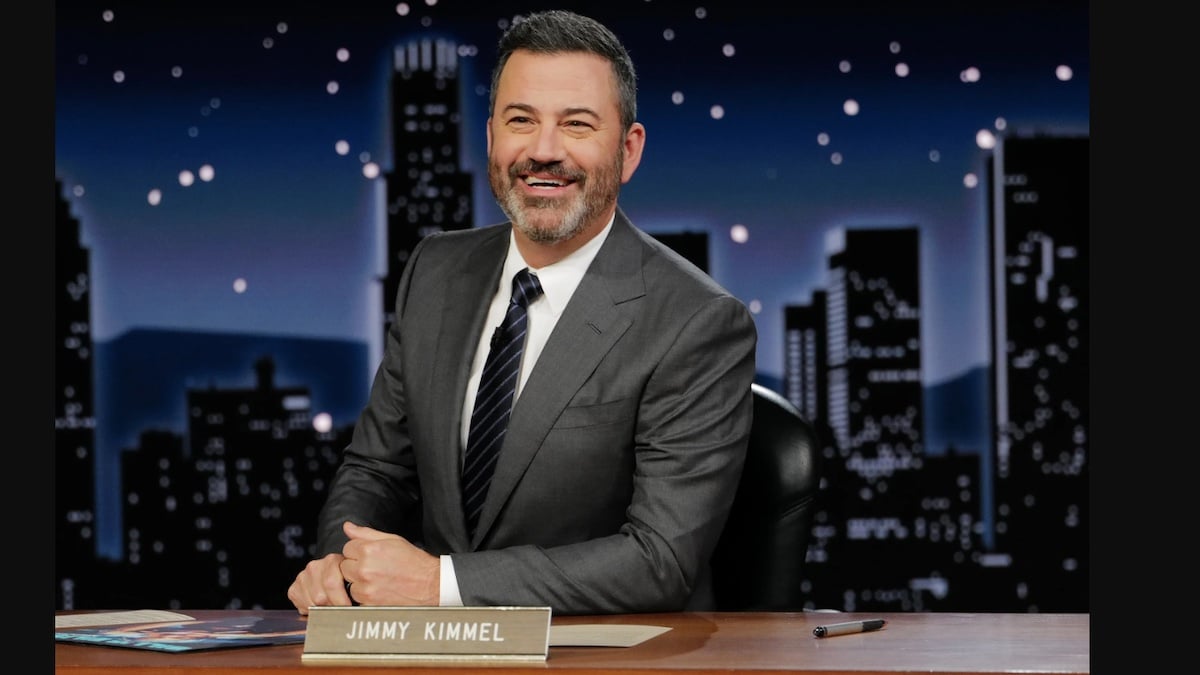
“For the whole 20-plus years of our show, in fact, I’ve been interviewing Americans who are running for office with no problem at all,” Kimmel told viewers. “Now that he is president, his FCC has threatened me, threatened our show, threatened our network ABC, our affiliates, our local stations—based on simple traditional editorial decisions… Out of consideration for our local stations, especially our ABC affiliates in Texas who would have to deal with this nonsense, my interview tomorrow with James Talarico will not air on television.”
The Talarico interview was subsequently uploaded to YouTube, where it had approached seven million views by September 13 as the controversy surrounding the broadcast decision continued to attract attention.
Fans Blast Disney’s “Stick to Sports” Double Standard
The Cruz appearance prompted renewed debate among sports fans and media critics over the role of politics in sports programming. Critics argued that Disney’s decision to give Cruz a high-profile platform to discuss legislation on College GameDay while moving a Democratic candidate’s Kimmel interview off ABC television created a perceived double standard.
Sports media outlets like Awful Announcing immediately pointed out the contrast between Disney providing a high-profile platform for Cruz to talk about politics on College GameDay and the decision to move Kimmel’s Talarico interview to YouTube the same week.
Social media erupted with criticism from fans across the political spectrum:
“In what universe does a politician belong on a college football pregame show?” wrote popular sports account SEC Unfiltered.
“It’s ‘Keep politics out of sports’ unless it’s their politics,” commented another fan on X. “Most embarrassing moment in College GameDay history.”
“Fine, have Ted Cruz on. But have on Senator Chris Murphy, who opposes this bill,” argued another critic, pointing out the lack of balanced coverage.
To make matters worse, critics also pointed to Cruz’s history of being booed or heckled at sporting events, including at Yankee Stadium in 2022 and during the Houston Astros’ World Series parade.
The Regulatory Defense vs. Public Perception
In response to the growing backlash, FCC Chairman Brendan Carr posted on social media to defend Cruz’s appearance on ESPN, saying no rules were broken. Carr argued that federal equal-time requirements apply to qualifying broadcast-station uses and said the requirements did not apply to Cruz’s ESPN appearance because ESPN is a cable network rather than an over-the-air broadcast station. Carr also noted that Cruz is not a candidate in the 2026 midterm elections.
However, for viewers and Disney park fans who expect fairness and consistency from the Mouse House, legal distinctions do little to erase the contrasting optics. Critics argue that the different treatment of the two appearances raises questions about how Disney’s separate media properties handle political content.
As Disney continues to navigate an increasingly polarized media landscape, the contrasting treatment of the two appearances has become a point of debate over the intersection of politics, sports programming, broadcast regulation, and editorial decision-making.