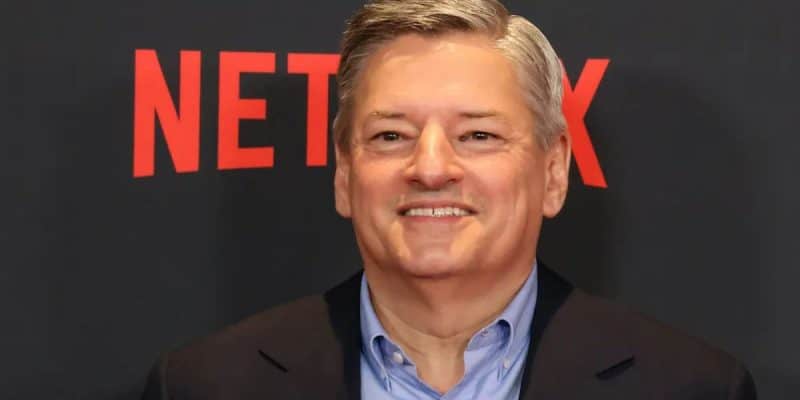
 Credit: Netflix
Streaming has always been a numbers game. Subscribers, hours watched, titles produced, money spent. Netflix built its dominance on the ability to produce more content, more quickly, than traditional studios could manage, and to deliver that content directly to screens without the friction of theatrical releases or cable schedules. For more than a decade, the company has operated on the principle that more is better and that speed matters, and it has invested accordingly.

Now it has added a new variable to that equation, and the scale of its adoption is larger than most observers probably expected.
In its second-quarter earnings report released Thursday, Netflix disclosed that roughly 300 programs across its library have used generative AI somewhere in their production process so far in 2026. Three hundred. That is not a handful of experimental projects or a pilot program being quietly tested on a few titles. It is a significant portion of the company’s active production slate, and the technology is being applied at every stage of the process, from initial concept and pre-visualization through post-production and release.
The disclosure landed alongside financial results that showed Netflix’s second-quarter revenue reaching $12.56 billion, up 13.4 percent year over year, with net income of $3.4 billion. Wall Street analysts had projected $12.59 billion in revenue and earnings per share of 79 cents. Netflix delivered 80 cents per share. The numbers were close enough to expectations that the AI disclosure, rather than the financials, became the more discussed element of the report, per Variety.
What the AI Is Actually Doing

Netflix singled out three programs specifically to illustrate how the technology is being used in practice.
The Indian sports thriller series Glory, the Brazilian soccer miniseries Brasil 70: A Saga do Tri, and the American Revolution-focused docuseries The American Experiment were each cited for their use of generative AI to create what Netflix described as “highly complex sequences” including enhanced crowd sizes and battle sequences.
The American Experiment example came with the most specific detail. Netflix co-CEO Ted Sarandos said on the company’s earnings call Thursday that 17 minutes of AI-enhanced footage in the docuseries “expanded the scope of the series that just wouldn’t have been feasible before” and that those sequences were produced “twice as fast and at half the cost of previous options.”
That framing matters. Sarandos was not describing AI as a tool that slightly improved efficiency. He was describing it as a tool that made certain scenes possible that would not have existed otherwise. Netflix echoed that position directly in its shareholder letter: “In some cases, productions would have had to leave out key shots and sequences in the absence of GenAI technology.”
The broader application spans the entire production pipeline. Netflix described the technology’s usage as expanding “across every level of a program’s production process,” which means it is not limited to visual effects or post-production polish. It is involved from the conceptual stages through to release.
What Sarandos Said About AI and Creative Work
The disclosure invited an obvious question about what this means for the human workforce behind film and television production, and Sarandos addressed it directly on the earnings call.
“We believe it takes great artists to make something great, and AI is not changing that,” he said. “Movies are being made by people who make movies. AI provides them with better tools to make them even better.”
He went further on the question of what the technology does and does not do. “We are increasingly leveraging these tools to deliver higher-quality output more quickly and at a lower cost than traditional methods,” the company stated. But Sarandos added a qualifier that has appeared consistently in his public statements on the subject: speed and cost savings only matter if quality follows.
“I don’t think faster and cheaper matters if it’s not better,” he told Politico in March, and the earnings call echoed the same position.
Netflix’s acquisition earlier this year of InterPositive, the company founded by Ben Affleck, gives some texture to what the practical implementation looks like. Sarandos described the deal’s purpose as giving filmmakers AI tools that work specifically with their own production materials. “Using their own dailies, using their own production materials to make the film that they’re making better,” he said. “Still requires writers and actors and lighting techs and all the things that you’d use to make a movie, but be able to make the movie more effective, more efficient.”
The InterPositive deal was still in its “early days” according to Sarandos, but he noted the company had already seen its impact alongside Netflix’s other in-house tools.
Why This Matters Beyond Netflix
Netflix is not the first entertainment company to use generative AI in production and it will not be the last, but the scale of the disclosure is significant. Three hundred programs in a single earnings period is a data point that establishes AI-assisted production not as an experiment but as a standard operating procedure at one of the largest content producers in the world.
Netflix has also been public about AI’s role in other parts of its business, including helping users find new titles through its recommendation systems and fueling its advertising business. The company has also been building an AI animation studio. The Q2 earnings disclosure adds the production side of the business to a list of applications that suggests the technology is now woven into the company’s operations at multiple levels simultaneously.
For the broader entertainment industry, the disclosure provides a data point that will be difficult to ignore. If generative AI can genuinely produce complex sequences twice as fast and at half the cost while meeting Netflix’s quality threshold, the pressure on other studios and streamers to adopt similar tools will be significant. The competitive dynamics of the streaming era have consistently pushed companies toward efficiency, and AI represents the most significant efficiency lever the industry has encountered in years.
The creative labor question that Sarandos consistently addresses in public, the concern that the technology displaces writers, actors, cinematographers, and other professionals, remains a live debate. His repeated framing of AI as a tool that enhances rather than replaces creative work is consistent with what Netflix wants investors, workers, and the public to believe. Whether that framing holds as the technology matures and the competitive pressure to use it more aggressively increases is the question the industry will be answering over the next several years.
If you have been watching any of the Netflix titles named in the disclosure, Glory, Brasil 70: A Saga do Tri, or The American Experiment, share your reaction in the comments. And if you have thoughts on where the line falls between AI as a production tool and AI as a replacement for creative labor, this is a conversation worth having openly. The entertainment landscape is changing quickly and the audience’s perspective on these choices matters more than the industry sometimes acts like it does.