25
25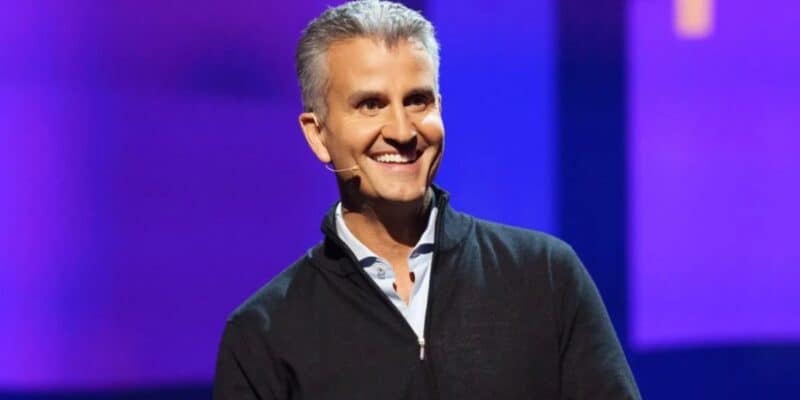
 Credit: Disney
When Josh D’Amaro officially walked into the corner office at Team Disney Burbank as Chief Executive Officer, industry insiders and Wall Street analysts expected a honeymoon period defined by parks-centric nostalgia and corporate continuity.
Instead, the executive, known for his pristine public-relations image and charismatic leadership style, has found himself thrust into a high-stakes constitutional showdown that may well define his legacy.
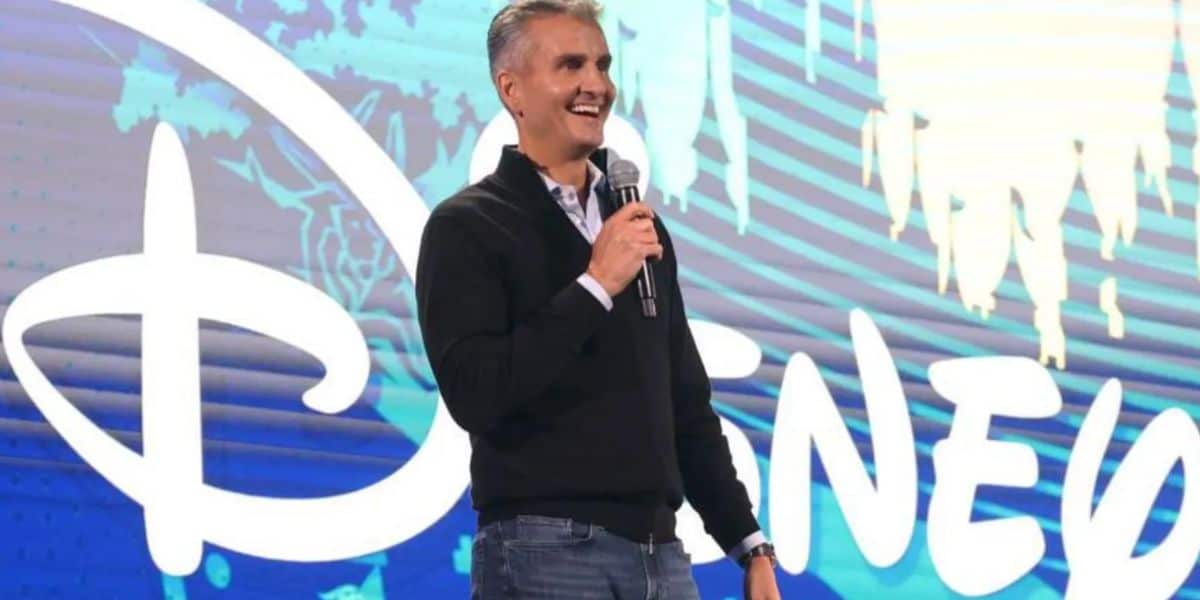
The first 100 days of any chief executive’s tenure are traditionally categorized by rapid restructuring, shifting organizational charts, and distinct strategic pivots designed to appease activist investors.
However, Josh D’Amaro’s opening act as the leader of The Walt Disney Company has bucked the historic trend. On the surface, D’Amaro’s internal corporate governance has been remarkably quiet. He has kept the baseline managerial architecture built by his predecessor, Bob Iger, largely intact, choosing operational stability over disruptive, anxiety-inducing overhauls.
Yet, beneath this calm corporate exterior lies a defining, high-stakes battle that has instantly recontextualized D’Amaro’s leadership style. Rather than easing into the job, D’Amaro has drawn a defiant line in the sand against the federal government, directly standing up to President Donald Trump’s aggressive regulatory push to revoke or challenge ABC’s legacy broadcasting licenses.
It is a calculated, steel-spined maneuver that has shocked Washington and demonstrated that the former theme parks chief is entirely prepared to operate as a wartime media mogul.
The Blueprint of Continuity: Steadying the Ship Inside Burbank
To understand the calculation behind D’Amaro’s first 100 days, one must examine the operational exhaustion Disney suffered over the previous half-decade.
Having endured successive waves of structural whiplash—moving from the late-stage Iger era to Bob Chapek’s highly centralized reorg, back to Iger’s reactive restructuring—the company’s internal divisions desperately craved strategic predictability. D’Amaro recognized this institutional fatigue immediately.
Consequently, his internal directives since taking the helm have focused almost entirely on execution rather than reinvention. Rather than firing high-profile executives or shifting reporting lines, D’Amaro has empowered Disney’s existing divisional heads to focus heavily on their current multi-year targets.
In the streaming sector, he has doubled down on Iger’s late-stage mandate to drive core profitability and stabilize average revenue per user (ARPU) across Disney+ and Hulu.
In the experiences sector, the massive $60 billion capital expenditure plan remains locked in, with construction accelerating on high-profile expansions such as Villains Land at Magic Kingdom and Monstropolis at Disney’s Hollywood Studios. By signaling to the market that Disney’s core operational engine does not require an emergency overhaul, D’Amaro successfully stabilized institutional investor sentiment.
The message was unmistakable: the foundational strategy was already correct; it simply required a leader with a steady hand and a unified corporate culture to execute it.
The Regulatory Firestorm: Trump’s FCC vs. ABC News
While D’Amaro maintained an intentional status quo inside the walls of Burbank, an existential threat was rapidly developing on the political horizon. Following a highly contentious political landscape and subsequent debate cycles, the Trump administration intensified its long-standing rhetoric against legacy media corporations, placing Disney-owned ABC News squarely in its crosshairs.

The threat quickly transitioned from standard campaign-trail grievances to a coordinated regulatory assault. Utilizing a newly aggressive, highly politicized push at the Federal Communications Commission (FCC), the administration began laying the groundwork to actively challenge, delay, or outright revoke the over-the-air broadcasting licenses held by ABC’s owned-and-operated local television stations.
In major media markets like New York, Los Angeles, and Chicago, these local stations form the financial and structural backbone of the entire ABC network. A successful challenge to these licenses would look less like a standard regulatory fine and more like a structural dismantling of Disney’s linear media business.
Historically, when faced with severe political or regulatory pressure, major media conglomerates have leaned heavily on back-channel diplomacy, public neutrality, or structural compromise to avoid damaging their stock prices.
Many expected D’Amaro—an executive whose entire career was built on the universally safe, non-partisan, public-pleasing world of theme park operations—to seek a quiet, behind-the-scenes settlement or adjust the network’s editorial tone to pacify Washington.
Standing the Ground: D’Amaro’s Constitutional Defensive
Instead, D’Amaro chose to fight. In his first major external crisis as CEO, he bypassed corporate passivity and launched a comprehensive, multi-front legal and public-defense campaign for ABC’s institutional autonomy.
Behind the scenes, D’Amaro mobilized Disney’s elite corporate legal apparatus, assembling a formidable team of First Amendment attorneys and administrative law experts to prepare an immediate, aggressive counter-offensive against any formal FCC filings.

Publicly, D’Amaro has framed the battle not merely as a corporate dispute over asset protection, but as a fundamental defense of the free press and constitutional norms. D’Amaro has made it clear that Disney would not allow its editorial integrity to be compromised or leveraged as a bargaining chip for corporate favor.
This steely posture has sent a powerful ripple effect through the entire media industry. By refusing to blink in the face of a direct presidential threat, D’Amaro has completely upended the prevailing public narrative that he lacked the administrative grit and political savvy required to steer a legacy news and media division through a hostile political landscape.
The Evolution of a Corporate Legacy
As Josh D’Amaro crosses the threshold of his first 100 days, the profile of his leadership is becoming distinct. He is proving to be a highly adaptive leader capable of dual-track management: preserving calm operational continuity on the inside while executing a fierce, unyielding defense of corporate autonomy on the outside.

The long-term implications of his battle with the FCC remain unwritten, but the strategic victory inside the company is already secure. D’Amaro has successfully transitioned from the charismatic, universally liked executive walking down Main Street, U.S.A., into a battle-tested chief executive willing to go to war for his assets and his workforce.
The invisible walls of the Disney kingdom are no longer just about guarding theme park property—they are being deployed to defend the company’s institutional place in the American media landscape. As Disney looks toward a complex, highly regulated future, Josh D’Amaro has proven that behind the pristine corporate smile lies an unyielding will to fight for the future of the House of Mouse.