 Credit: Six Flags
The concept of the “flash mob” was once a lighthearted internet novelty, characterized by coordinated public dances or quirky pranks. Today, that digital phenomenon has evolved into a dangerous public safety crisis. Across the United States, major cities and entertainment districts are grappling with “teen takeovers”—sudden, massive gatherings of young adolescents organized entirely via social media that rapidly deteriorate into property destruction, looting, and severe physical violence.
As the country transitions into the high-traffic summer travel season, this viral trend is no longer contained to urban street corners and shopping malls. Instead, violent teen takeovers have officially spilled over into the theme park world, threatening the safety of millions of vacationing families. With school districts letting out across the nation, law enforcement agencies and amusement park operators are bracing for what could be an unprecedented summer of coordinated chaos.
A Coast-to-Coast Wave of Violence: Inside the National Trend
The rapid escalation of these events was recently spotlighted in a national investigative report by NBC News. The broadcast revealed that what began as rowdy adolescent meetups has mutated into a deeply organized, nationwide threat that catches local communities completely off guard.

According to data compiled by law enforcement, the digital blueprint for these takeovers relies heavily on algorithmic amplification on platforms like TikTok and Instagram. Using no-cost AI image generators, tech-savvy teenagers are rapidly producing highly professional event flyers and distributing them across regional group chats. Within hours, thousands of minors converge on a singular location with a shared objective: to cause maximum disruption for digital clout.
The real-world consequences of these gatherings are turning increasingly bloody:
- Tampa, Florida: Earlier this month, body camera and aerial footage captured total anarchy at Curtis Hixon Park. A massive teen takeover resulted in large-scale brawls, forcing police to arrest 22 individuals, some as young as 12 years old. During the melee, investigators seized two loaded firearms from minors.
- Milwaukee, Wisconsin: Law enforcement officials reported a staggering breaking point last month when authorities were forced to respond to 12 separate teen takeovers in a single weekend. Gatherings at locations like the Bayshore Mall and Moody Park quickly descended into mass brawls, reckless driving, and active gunfire.
- Washington, D.C.: Surveillance footage captured a chaotic scene inside a local Chipotle, where a swarm of teenagers completely bypassed the counter, engaging in a violent group brawl that destroyed the restaurant’s interior and sent patrons fleeing for their lives.
- Metro Detroit, Michigan: The trend has rapidly metastasized out of urban centers into suburban communities like Pontiac, where officials are issuing urgent safety warnings after digital flyers began promoting upcoming takeovers targeting local recreational areas.
Faced with growing desperation to rein in the crisis, cities are turning to extreme legal measures. In Chicago, where takeovers have historically paralyzed downtown corridors, city officials are weighing a strict parental liability ordinance. The proposal would allow prosecutors to criminally charge the parents of minors arrested at teen takeovers after the city’s 10:00 p.m. curfew with contributing to the delinquency of a minor—a Class A misdemeanor carrying up to a $2,500 fine and 364 days in county jail.
Chaos on International Drive: The ICON Park Crisis
The most alarming development for the tourism industry occurred in the heart of Orlando, Florida—the undisputed theme park capital of the world. On April 25, 2026, the intersection of social media trends and amusement park vulnerability erupted into violence at ICON Park, a prominent open-air entertainment plaza on International Drive known for the massive Orlando Eye observation wheel.
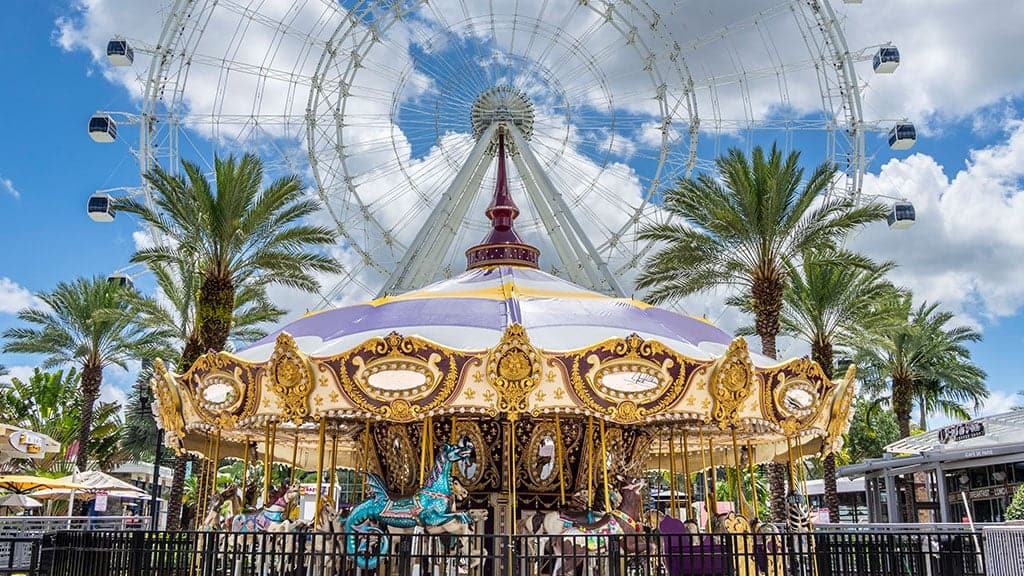
Without warning, more than 1,000 teenagers flooded the property after a takeover flyer circulated online. Within minutes, the manicured walkways under the Ferris wheel turned into a battleground. Swarms of adolescents began running wildly, screaming, and instigating violent fights across the main lawn.
The scale of the crowd triggered immediate panic among visiting tourists, many of whom were traveling with small children. Witnesses described a scene of pure terror, with families scrambling into nearby restaurants and shops, begging employees to lock the doors. Because of the sheer volume of youth sprinting away from the plaza, many diners initially believed they were fleeing from an active shooter.
It required an emergency deployment of more than 50 Orange County Sheriff’s Office (OCSO) deputies to break up the fights and safely disperse the crowd. Ultimately, nine juveniles between the ages of 13 and 16 were arrested, facing severe charges including affray, trespassing, resisting an officer with violence, and battery on a law enforcement officer. Two responding deputies suffered injuries serious enough to require hospitalization.

In an interview with Orlando’s Morning News on May 21, 2026, Orange County Sheriff John Mina sent a fierce message to anyone planning to participate in these digital flash mobs, stating:
“They can be very, very dangerous. They can disrupt businesses. They can ruin a fun time for people who are out there just looking to have a good time, so we’re definitely cracking down on it. It’s a zero-tolerance approach.”
The Summer Perfect Storm: Why Theme Parks Are the Ultimate Targets
The timing of this trend could not be worse for the amusement industry. Historically, theme parks, boardwalks, and water parks experience a massive surge in local teenage attendance between late May and early September. However, the structural realities of modern theme parks make them uniquely vulnerable to the teen takeover playbook.

Amusement parks are designed to be high-capacity, open-air “crowd sponges.” They feature expansive promenades, easily identifiable geographic landmarks perfect for digital meetups, and a built-in audience of tourists. For a teenager seeking internet notoriety, capturing video of a chaotic brawl with a world-famous roller coaster or a neon-lit midway in the background provides the ultimate recipe for a viral social media post.
Furthermore, these events are pushing past the boundaries of traditional amusement parks. In nearby Daytona Beach, a massive spring break takeover heavily promoted by online party organizers resulted in total gridlock along the coast, prompting the Volusia County Sheriff’s Office to file a historic civil lawsuit against the digital promoters to recover the immense costs of emergency police deployments.
Defending the Gates: The New Era of theme park Security
As the summer travel season officially launches, the threat of recurring takeovers has forced major shifts in how theme parks manage security. Following the April riot, ICON Park leadership immediately enacted a strict Youth Chaperone Policy. Under the new guidelines, all visitors under 18 must be accompanied by a parent or legal guardian over 21 after 6:00 p.m. on weekends.

This mirrors protective measures already deployed by major regional amusement park operators, including Cedar Fair and Six Flags, which implemented mandatory chaperone programs at parks like Knott’s Berry Farm and Worlds of Fun following similar youth-led disruptions.
Moving forward, the battle against teen takeovers will be won or lost in the digital space. Law enforcement agencies across Florida and the Midwest have established dedicated cyber-monitoring units tasked with actively scraping TikTok, Instagram, and Discord for keywords related to local meetups.

Theme parks are no longer just spaces of curated family escapism; they are on the front lines of a modern cultural and technological battleground. For families planning their summer vacations, the message from both local police and corporate park operators is uniform: heightened security, strict curfews, and zero-tolerance policing will be the new normal to keep the gates safe from the threat of the digital mob.