
 Credit: Sloth World
If you have been following the Sloth World Orlando story since it first broke into public consciousness through an investigative report that revealed the deaths of more than 31 sloths connected to the planned International Drive attraction, you already know that each update has brought new information that makes the situation look more serious than the one before it.
The pattern has been consistent since the beginning. A Florida Fish and Wildlife Conservation Commission inspection report surfaced documenting dozens of animal deaths. Orange County issued a stop-work order after finding building code violations at the warehouse connected to the operation.
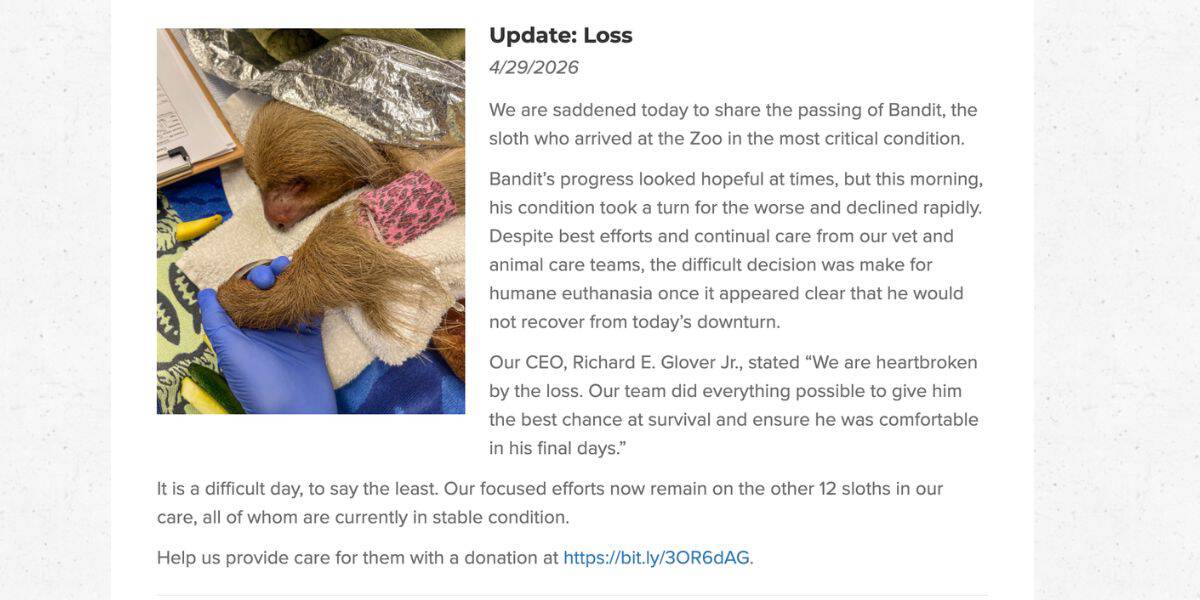
Florida State Representative Anna Eskamani went public, demanding criminal accountability and pushing for additional scrutiny from higher levels of government. One of the 13 sloths transferred to the Central Florida Zoo, a three-month-old baby named Bandit, died after arriving in critical condition. The company filed for bankruptcy protection.
And now, in the development that represents the most significant escalation of official involvement since the story first emerged, the Florida Attorney General’s office has confirmed it is assisting in a criminal investigation into the deaths of the sloths connected to Sloth World, working alongside State Attorney Monique Worrell in what marks a new level of governmental scrutiny over what happened to these animals before the attraction ever opened its doors.
The Attorney General Steps In to the Orlando News
Florida Attorney General James Uthmeier confirmed in a letter released May 1 that his office is assisting the Ninth Judicial Circuit of Florida in a probe into Sloth World. The announcement came after Representative Eskamani pushed for additional scrutiny following the FWC’s earlier conclusion that its investigation found no criminal wrongdoing in the sloth deaths, a conclusion that generated significant criticism from Eskamani and others who argued that the regulatory framework being applied was inadequate for the severity of what had occurred.
The attorney general’s office confirmed it would work alongside State Attorney Worrell, though Worrell’s office has not commented publicly and did not respond to requests for additional information at the time of the announcement.
The FWC’s prior finding that Sloth World did not violate any state regulations was one of the more controversial conclusions to emerge from the investigation, and the agency’s statement that a prior civil investigation concluded without a citation or written warning despite the deaths of dozens of animals has continued to draw criticism.
The agency stated that subsequent inspections found the facility compliant with care and housing standards, and that while the deaths were tragic, there was no legal basis for enforcement action. That position has not been accepted by Eskamani, who described herself as deeply dissatisfied with the FWC’s response and called it unacceptable that deaths caused by what appears to be clear negligence would not result in meaningful accountability.
What Investigators Found Caused the Deaths at the Orlando Business
The FWC reports identified a combination of factors that likely contributed to the sloth deaths rather than pointing to a single cause. Those factors included viral infection, cold exposure, stress during transportation, and exposure to a warehouse environment. In December 2024, Sloth World received its first shipment of 21 sloths from Guyana, but they arrived at a warehouse that was not ready to receive them.
At least once during that period, the sloths were left alone in a cold, unheated warehouse. Wildlife disease experts and necropsy reports indicate the sloths were under immense physiological distress from the moment of their capture from the wild through their international shipment and housing conditions.
The biology of sloths makes them particularly vulnerable to the very kind of stress they are subjected to. Unlike most mammals, sloths do not have a strong fight-or-flight response; instead, they rely on camouflage for survival. When handled by strangers or placed in noisy, high-traffic environments, they do not struggle or vocalize distress.
Instead, they internalize the stress, their bodies flood with cortisol, and a cascade of physiological consequences can follow that ends in organ failure. Necropsy reports from the Sloth World animals documented swollen stomachs, ulcerated mouths, damaged spinal cords, organ failure, pneumonia, and, in some cases, the presence of viruses.
Sloth World’s Owner and the Bankruptcy Filing
The attorney general’s letter confirmed that Sloth World is filing for bankruptcy protection, adding a legal and financial dimension to a story that has already involved regulatory violations, building code citations, an expired FWC permit, and now a criminal investigation.
The facility’s owner, Benjamin Agresta, initially described government records documenting the deaths as completely fictional before later attributing the deaths to a virus. Neither Agresta nor former vice president Peter Bandre responded to requests for comment on the investigation. A former Sloth World employee had previously contradicted the owner’s account, stating there were no viruses and attributing the deaths to poor conditions and inadequate care.
Florida Attorney General James Uthmeier said Friday that his office is assisting the Ninth Judicial Circuit Court of Florida with an "ongoing criminal investigation" into Sloth World Orlando, following the deaths of numerous sloths under its care. https://t.co/SS3OMFxe3j
— KTVU (@KTVU) May 2, 2026
Import records indicate Sloth World imported more than 60 wild sloths in total. As of late April, the company held 13. Those 13 were transferred to the Central Florida Zoo, where one of them, Bandit, a three-month-old baby sloth who arrived in critical condition, showing signs of severe lethargy, dehydration, nutritional and electrolyte imbalances, and gastrointestinal complications, subsequently died.
Federal and Advocacy Involvement
The investigation has now expanded beyond Florida’s state-level government. U.S. Representative Maxwell Alejandro Frost asked the U.S. Department of Agriculture to investigate Sloth World, and PETA sent an open letter to the Florida Department of Law Enforcement requesting a criminal investigation into Agresta, Bandre, Sloth World, and its related business, Sanctuary World Imports, for apparent aggravated cruelty to animals.
PETA cited a Florida statute that states a person who owns or has custody of any animal and fails to act in a way that results in cruel death commits aggravated animal cruelty, a felony of the third degree. Governor Ron DeSantis also commented on the situation at a press conference, describing it as really, really weird and indicating that the FWC would need to rectify whatever the matter was.
Representative Eskamani has indicated she is working across the aisle on future policy to strengthen FWC oversight and establish clearer restrictions and standards for permits required to possess, exhibit, or sell certain non-domesticated wildlife. Those potential changes include requiring that all animal deaths under those permits be reported and made public, and establishing a pause on permit renewal until a full investigation into deaths is completed.
The Sloth World story began as a local Orlando animal welfare concern and has become a state and federal investigation involving the attorney general’s office, federal representatives, animal advocacy organizations, and the governor. The criminal investigation is now underway. The company is filing for bankruptcy. And the regulatory gaps that allowed this to happen are now the subject of proposed legislative action. The story is not over.